Update 14

Huge update this week thanks, again, to J. 

  • There is a new picture of French  militant anti-fascists.
  • Reposting of an article from Non Stop Apartheid Picket  about AFA’s defence of the picket
  • Lots of new stickers from Red Action, the IWCA, AFA, Connelly Society, TAL, the SWP and Workers Power! – Thanks J
  • Lots of new fascist stickers from the NF, Third Position, Independent Ulster Movement and the Patriotic Vegan and Vegetarian Society! – Thanks J
  • Couple of new newspaper articles on fascist activity in Scotland from 1991 and an article from 1994 on a Nazi gig being stopped (Articles with “<<” after it). – thanks to J
  • A load of local bulletins from Notts, Edinburgh, Birmingham and Tyne and Wear. – Thanks to J
  • A new post containing various Red Action publications.
  • 11-15 new leaflets on the Freedom of Movement, race attacks and the jailing of three anti-fascists.


I have created some geographical posts:

  1. Birmingham Anti-Fascists – contains their leaflets and a document on why they resigned from AFA, plus more
  2. Edinburgh Anti-Fascist Action – leaflets and a document on their activity, plus more
  3. Glasgow Anti-Fascist Action – leaflets on who they are and why they do it, plus more
  4. Leeds Anti-Fascists – interesting memo on World in Action claims on infiltrating Leeds AFA, plus more
  5. Leicester Anti-Fascists – document on an AFA conference
  6. Brighton Anti-Fascist Action – three interesting and heated letters between AFA and Searchlight.


Brighton Anti-Fascist Action

This post will list materials relating to Brighton Anti-Fascist Action.
I have received a series of fairly heated letters between Tony Greenstein of Brighton AFA and Gerry Gable of Searchlight. They reveal tense relations between t he two.

  • 24/06/93 – Brighton AFA’s letter to supporters on a ‘security alert’ in Midlands AFA, Searchlight’s relationship with the state, suspicions on Searchlights relationship with AFA, issues with Fighting Talk, problems within AFA
  • 13/07/93 – Searchlight’s Gerry Gable replies to Brighton AFA’s letter. It’s heated from the beginning and deals with the allegations.
  • 16/07/93 – Tony Greenstein replies back to Searchlight. He deals with the allegations of taking copies of Searchlight without paying. He goes on to discuss the Class War inquiry, Lara O’Hara, and another 6 points.

Leeds Anti-Fascists

This post will contain materials regarding anti-fascism in Leeds

“Though people are probably aware that the WIA ‘expose’ was set up by Searchlight, Searchlight also warned AFA against having any involvement in the expose! It is also worth noting that the letter from Leeds AFA attacking the makers and by extension Searchlight is signed by ‘Paul’. In the 1997 AFA inquiry into Leeds AFA as whole, ‘Paul’ admitted to being a Searchlight asset…” Joe Rielly.

  • Leeds AFA letter on an international militant anti-fascist meeting, but, it also contains criticisms of London AFA

Glasgow Anti-Fascist Action

This post will contain material from Glasgow Anti-Fascist Action.


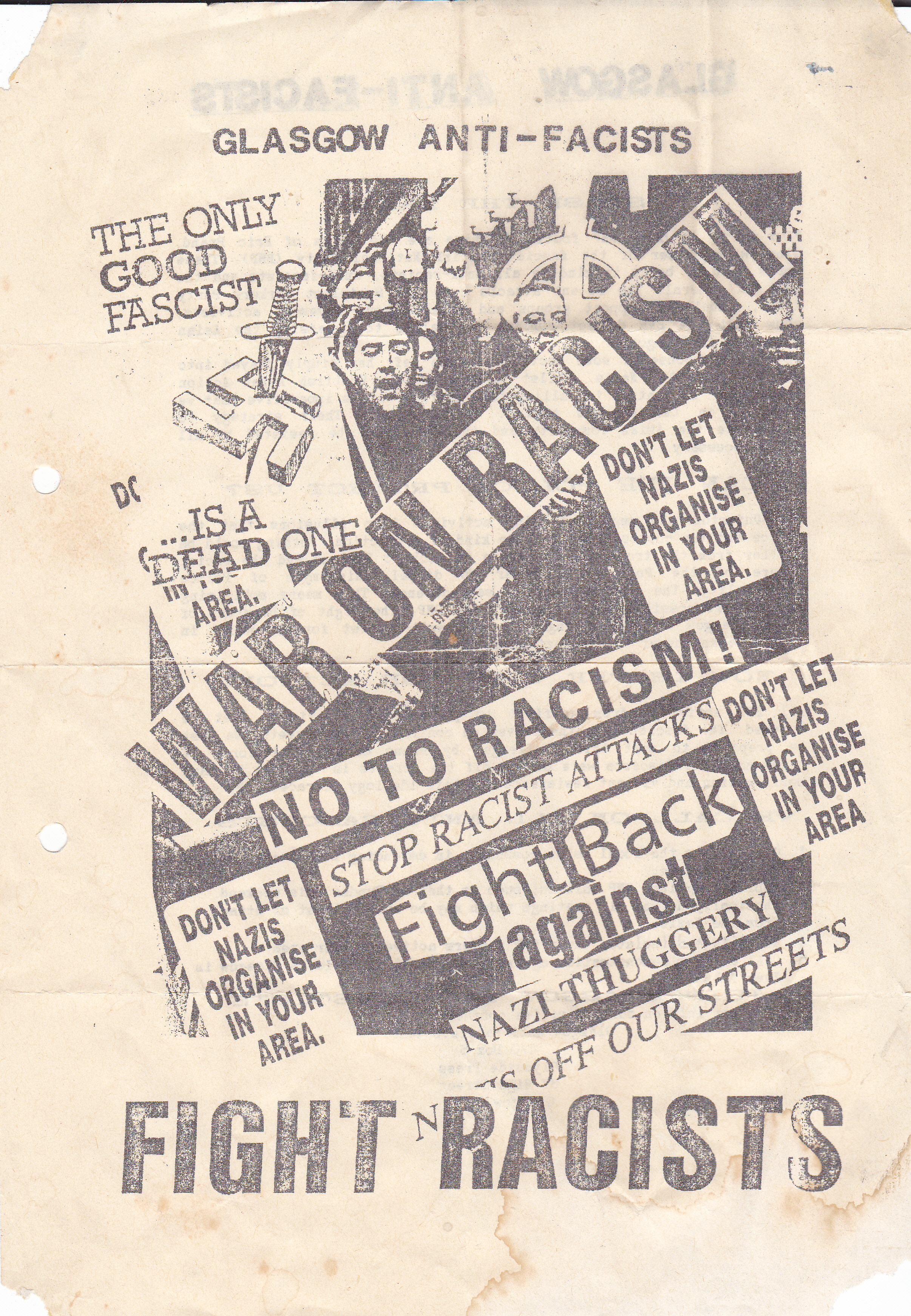
Above: The first leaflet put out by Glasgow Anti-Fascists around 1989/90. GAF was the forerunner to the Anti-Fascist Action (AFA) branch in the city.


  • Glasgow AFA: a leaflet about who they are and what they do.
  • Glasgow AFA leaflet for a public meeting regarding a rise in racist and fascist activity.
  • Glasgow AFA leaflet for another public meeting regarding racist attacks.

Birmingham Anti-Fascists

This post will list material from Birmingham Anti-Fascist Action/Alliance.

  • Public Statement (12/07/94): Brimingham Anti-Fascist Action resigns from Anti-Fascist Action and becomes the Birmingham Anti-Fascist Alliance. This statement details the reasons why.
  • Organisation Mailing (08/94): BAFA write to Edinburgh AFA following their resignation.
  • Fighting Fascism #4 (Summer 1994): BAFA’s newsletter of Birmingham.

Rituals of Remembrance and Protest.

It’s 11.00 on the 11th November as I start writing this.  The campus has just slipped into observing a two-minute silence to mark Armistice Day and I’ve slipped into the silent rage that these celebrations of imperialist slaughter always provoke in me.  To shift my mood a little, I remember instead two rituals of remembrance that I associate with the Non-Stop Picket of the South African Embassy back in the 1980s.

Remembrance Sunday was always a tense day on the Non-Stop Picket.  Situated in Trafalgar Square it was less than a mile away from the Cenotaph on Whitehall, the focus for state rituals of remembrance.  Sometimes the hordes of passing former servicemen and women passing the Picket on their way to or from the ceremony at the Cenotaph could be antagonistic towards the anti-apartheid cause (although that was not universally the case).  Those retired soldiers were never the real problem, though. The threat posed to the Non-Stop Picket on Remembrance Sunday was the annual parade passed the Cenotaph later in the day by the motley membership of the neo-fascist National Front and/or British National Party.  They definitely didn’t like anti-racists protesting against apartheid, and had a tendency to either try to launch full on assaults against the Picket or, more ‘subtly’, attempt to provoke violent arguments with picketers.  In response, each year on Remembrance Sunday large numbers of City Group supporters and other anti-fascists would mobilise and gather on the Non-Stop Picket to defend it against potential attack.  On 13th November 1988 in particular, hundreds gathered outside the Embassy in response to heightened fear of fascist attack.  In parallel to these mobilizations, activists from the Non-Stop Picket would often patrol the area with Anti-Fascist Action to spot and head off groups of fascists heading towards the Picket.

These anti-fascist mobilizations to defend the safety and integrity of the Non-Stop Picket once again highlight the ways in which, for the members of the City of London Anti-Apartheid Group, the politics of anti-apartheid solidarity activism could never be separated from anti-racist and anti-fascist work in Britain.

Weaving flowers into the Embassy Gates, Summer 1986 (Source: author)

There is one further way in which I want to remember rituals of remembrance associated with the Non-Stop Picket.  That is to consider the ritual practices that City Group developed to remember those freedom fighters killed by the apartheid regime.  When apartheid prisoners were executed, anti-apartheid activists were assassinated by South African agents, or the South African Defence Force (sic) massacred youth in the townships, City Group would respond to witness that act of state violence.  Very often this involved a ritual of placing flowers on the imposing, monumental gates of South Africa House.  Sometimes this would be a modest and spontaneous act by the protestors gathered on the Picket for a particular shift, but during the weekly Friday night rallies or other large gatherings, a dignified queue would form as scores of protestors waited to add their flowers to the Embassy gates until they were bedecked in  flowers of remembrance.  More often than not, the picketers would sustain the haunting melody of Senzenina, a song sung at political funerals in South Africa, throughout this act of witness, mourning and remembrance.

If poppy-wearing and the official two-minute silences of Armistice Day and Remembrance Sunday serve as nationalistic rituals that reproduce public support for continued military intervention around the world through the remembrance the fallen soldiers of past wars; then, the laying of flowers on the gates of the South African Embassy and the singing of Senzenina renewed the commitment of the picketers to stand in solidarity with those resisting apartheid in southern Africa.

This article is from the fantastic Non-Stop Against Apartheid blog.
Red Action: Various Literature

This post will list various literature from Red Action.


IWCA Literature

This post will list literature from the Independent Working Class Association.

  • IWCA Letter (1996): this letter is in reply to subscription and support to the IWCA.
  • IWCA Letter (1996): this letter is in reply to interest in joining the IWCA.
  • IWCA Letter (1996): this is a letter regarding a meeting in Glasgow.
  • IWCA Whalley Range leaflet: newsletter discussing the election of New Labour and the local battle against a mobile phone mast.

Also see the IWCA’s Filling the Vacuum document.