
When left-wing director Ken Loach agreed to make a film about Manchester United fans, it was widely assumed that he’d done so because this gave him the opportunity to work with Eric Cantona. Looking For Eric (2009), his uplifting revenge fantasy about a down-and-out postman played by Steve Evets (a former part-time bassist with The Fall), also deals with the fall-out from the Malcom Glazer takeover. In one memorable pub scene, fans argue between themselves about the merits of supporting breakaways FC United (‘the People’s Club’). But neither the enigmatic presence of Cantona nor the unresolved FCUM dilemma provides the main focus for the film, which is the idea that only through comradeship and solidarity can certain problems be overcome. Moreover, in the climax scene (‘Operation Cantona’), the film seems to suggest that the use of violence and the threat of violence are justifiable in certain circumstances – which isn’t wholly inappropriate for a film starring Eric Cantona. As Eric the postman tells Eric the footballer, regarding his reaction to the Crystal Palace fan who’d been hurling racist abuse at him, ‘That twat got what he deserved!’
Before looking at the film and its contexts in more detail, it’s necessary to look at the historical religious and political background of the Manchester derby. Angel Meadow (to the North-East of Victoria Station) was decribed in 1847 as ‘the lowest, most filthy, and the most wicked locality in Manchester … inhabited by prostitutes, their bullies, thieves, cadgers, vagrants, tramps, and, in the very worst sties of filth and darkness, those unhappy wretches, the low Irish.’ The Manchester Irish segregated themselves and were kept at arms length by the native English, who saw them as unclean and immoral. They shared rooms and cellars in the worst slums in the city (Angel Meadow, Ancoats and Little Ireland) and they were often willing to work when others weren’t. The boss of Newton Silk Mill (in Newton Heath) explained in 1834 what he did when his English employees were on strike: ‘I send to Ireland for ten, fifteen or twenty families … the whole family comes – father, mother, and children. I provide them with money … the communications are generally made through the friends of parties in my employ. I have no agent in Ireland.’ Predictably this led to resentment and it’s thought that whilst the presence of Irish labourers didn’t lower wages in Manchester, it probably helped keep them low.
In 1867, three Irishmen were executed for their part in the murder of a police officer during a raid on a prison van containing two prominent members of the Irish Republican Brotherhood (‘Fenians’). The execution took place outside the New Bailey Prison (in between Salford Central train station and the River Irwell) and the ‘Manchester Martyrs’ became legends, providing the inspiration for the Fenian anthem ‘God Save Ireland.’ The Orange Order was also prominent in Manchester and in July 1888, according to accounts in the Manchester Guardian and the Liverpool Mercury, they were the victims of a ‘pre-meditated’ sectarian attack by Irish Catholics in Ancoats. It’s often claimed that sectarianism wasn’t as big a problem in Manchester as it was in the port cities of Liverpool, Glasgow and Belfast, and this is probably true – but we shouldn’t ignore the fact that it is still a big part of Manchester’s history.
Into this heady mix came the two football clubs: Newton Heath were the works team of the Lancashire and Yorkshire Railwaymen, whilst Manchester City had their roots in the (Anglican) church. When Newton Heath decided to change their name in 1902, ‘Manchester United’ was only narrowly chosen ahead of ‘Manchester Celtic’ – an indication that even back then, United were regarded as the team of Welsh, Scottish and Irish immigrants. The man thought to be behind the new name, Louis Rocca was the son of Italian immigrants raised in Ancoats. The fact that he was so closely associated with Newton Heath during their period at a new ground in Clayton (1893-1910) suggests a support base within the nearby Ancoats Irish/Italian immigrant communities.
United moved to Old Trafford in 1910 and became the natural choice of club for the Salford dockers, many of whom lived in nearby Ordsall, and workers in Trafford Park, Europe’s largest industrial estate. These were areas which would develop a reputation for industrial militancy and even links with communism, perhaps best symbolised by Yuri Gargarin’s visit in July 1961. Incidentally Maine Road, City’s ground from 1923, was in the heart of Moss Side, a heavily Irish district, which suggests that the South Manchester Irish (now spread out through Chorlton, Levenshulme and Burnage) would be more likely to support City.
As United’s chief scout, Rocca apparently set up a scouting network of Catholic priests to search for the best young players. More importantly he kept in touch with Matt Busby (who played for City from 1928 to 1936) through the Manchester Catholic Sportsmen’s Club and was a key figure in Busby’s appointment as manager in 1945. Busby was a practising Catholic of Lithuanian descent from a mining village in North Lanarkshire. His assistant Jimmy Murphy, also a practising Catholic, was from the Rhonnda Valley (although his father had emigrated from Ireland presumably to look for work in the coal mines). Their club captain Johnny Carey was from Dublin and had begun his career playing Gaelic football.
In an October 2003 article for the Manchester Evening News on the rivalry with Rangers, Stuart Brennan claims that United ‘were perceived as Manchester’s ‘Catholic’ club’ in the 1950s just as Celtic were in Glasgow. Similarly Ed Vulliamy writes in a Guardian article in May 2012: ‘Tensions between loosely Catholic Irish United and loyalist City have dissipated over time…’ This may have been because of the signing (and indeed the success) of Protestant Northern Irish players such as George Best, Sammy McIlroy and Norman Whiteside. However this only really serves to explain why United developed a much broader support base abroad. Within Manchester itself, they were probably still seen as the Irish Catholic team or (bearing Rocca in mind) the team of immigrants in general.
Sectarian tensions re-emerged in Northern Ireland after the attacks on Civil Rights marches in 1968 and the deployment of British troops in 1969. The Birmingham pub bombings of November 1974, attributed to the IRA, increased anti-Irish sentiment in England and many club football fans in England began identifying with the loyalist slogan ‘No Surrender to the IRA.’ The same period also saw the rise of the far right in English towns and cities, starting with Enoch Powell’s ‘Rivers of blood’ speech in 1968 and culminating in the Battle of Lewisham in August 1977 between the National Front and their anti-fascist opponents. One of the best accounts of the period is ‘No Retreat: The Secret War Between Britain’s Anti-Fascists and the Far Right’ (2003) by Dave Hann and Steve Tilzey, both of whom were involved with the Socialist Workers’ Party but eschewed the more mainstream student-oriented nonviolence approach of the Anti-Nazi League and Rock Against Racism for a form of direct action resembling football hooliganism and gangsterism in its ultra-violence.
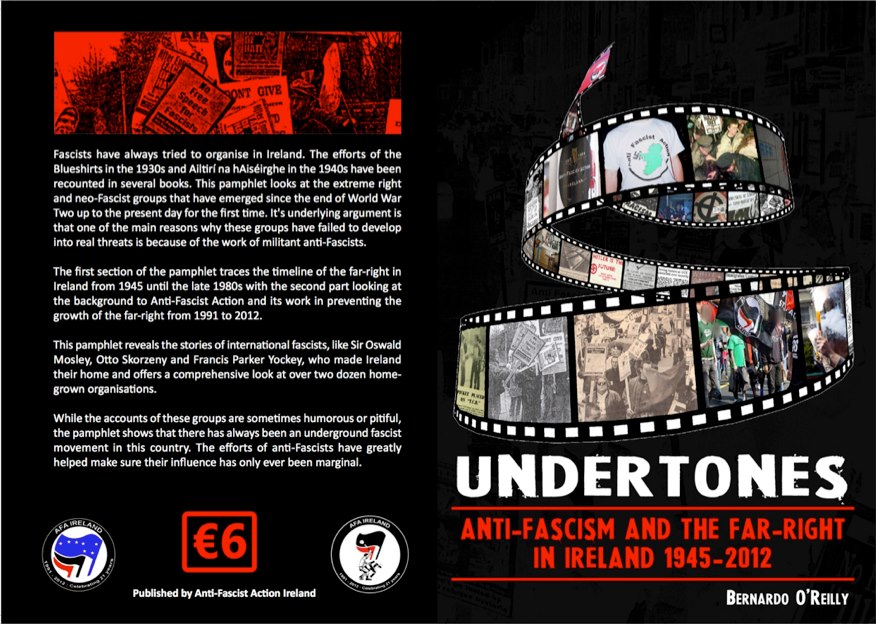
In his review of ‘No Retreat,’ far right commentator and sometime contributor to Press TV, Peter Rushton describes Manchester as ‘the capital of militant anti-fascism.’ The National Front were unable to sell their newspapers in Manchester city centre or outside the football grounds for fear of attack. A South Manchester branch of the BNP was closed down after the organiser decided it wasn’t worth making enemies with these people. It doesn’t come as a huge surprise considering the city’s history that there were close links between local Irish Republicans and militant Anti-Fascism. Manchester United fans were widely seen as more left-wing perhaps because of the club’s historic Irish Catholic links, perhaps because it was the dock workers’ club (note that many of the main left-wing clubs in Europe: Marseilles, Livorno, Feyenoord, St. Pauli, AEK Athens are linked with the dock workers).
Issue 12 of the Manchester United Anti-Fascist fanzine Red Attitude (available online at the Anti-Fascist Archive) contains an interview with Dessy Noonan, which covers the period and the politics. It should be remembered that Manchester in the late-1980s and early 1990s was more famous for its music scene, which began to overlap with the inter-locking gang wars of Salford, Cheetham Hill and Moss Side (which gave the city its nickname ‘Gunchester’). Noonan, whose brother Dominic was head doorman at the Hacienda, gave a TV interview (shortly before he was murdered in 2005) in which he boasts of having ‘more guns that the police.’ [The same programme, A Very British Gangster, features scenes of kids in United shirts playing football in Ringley Street, Harpurhey.] When asked by Red Attitude how Anti-Fascist Action had been able to prevent organised fascist groups from operating in Manchester, Noonan replies: ‘Quite simply because year after year we have out-violenced them. If they can’t operate politically without being attacked then they will struggle to attract anything more than losers and punchbags.’
In November 2004, Spike Magazine interviewed Hann and Tilzey, the authors of ‘No Retreat.’ The interview provides a useful context for the film Looking For Eric. When asked about the people they’ve ‘fought alongside,’ Hann notes: ‘We’ve had lots of football hooligans. Some of them just started out from the standpoint that they didn’t like the way the NF and the BNP were bullying people on the terraces.’ [The villian in Looking For Eric isn’t linked with the far right but he does bully Eric the postman.] They also claim that there is talk of a film being made based on the book, ‘a Ken Loach style thing.’ Whether or not Loach was ever approached about such a project, and we can assume that he may have been, Looking For Eric seems to have been heavily influenced by the idea of United fans coming together to ‘out-violence’ others for a good cause.
In the climax scene ‘Operation Cantona,’ a gang of United fans wearing Eric Cantona masks invade the villain’s house and ‘re-decorate’ it with red paint. After forcing the villain to acknowledge ownership of a gun that he’d been trying to pretend wasn’t his (and destroying the gun with a hammer), the leader of the gang, John Henshaw’s character Meatballs, tells him:
‘You don’t go near that family. You don’t go near them. You don’t look at them. You don’t talk to them. You don’t even think about them. Because you known what’ll happen? … We’re gonna turn up here with ten coachloads and we’re gonna take this house apart, brick by fuckin’ brick … And if you try and run away to some bolt-hole in Blackpool or some rabbit-hole in the Outer Hebrides, we’ll find ya. I’ll find ya – you know why? [raises hammer] ‘Cause I’m a fuckin’ postman!’
At this point, the gang of Cantona-masked intuders break into a round of applause and Meatballs (wearing his FC United shirt) predictably leads them on in a rousing chorus of ‘Ooh Aah Cantona.’
The film’s message is not anti-fascist, it is anti-bullying. But it does raise some interesting questions: Did Ken Loach consider making a film about Anti-Fascist Action? And to what extent was he influenced by the links between the United fans and AFA? I would imagine Loach, whilst sympathetic to the aims and achievements of AFA, probably feels more comfortable with the Ghandi-inspired ideal of nonviolence. Whilst it is incredibly violent, ‘Operation Cantona’ is ultimately a comic scene and Looking For Eric is hardly a left-wing version of The Football Factory.
Meanwhile it seems left-leaning United fans have abandoned the Glazer-owned club for FCUM, where a red-and-black Sandinista banner bears the Anti-Fascist slogan ‘No Pasaran.’
By Tom Riley
This article is from In Bed with Maradona.




 Anti-Fascist Archive