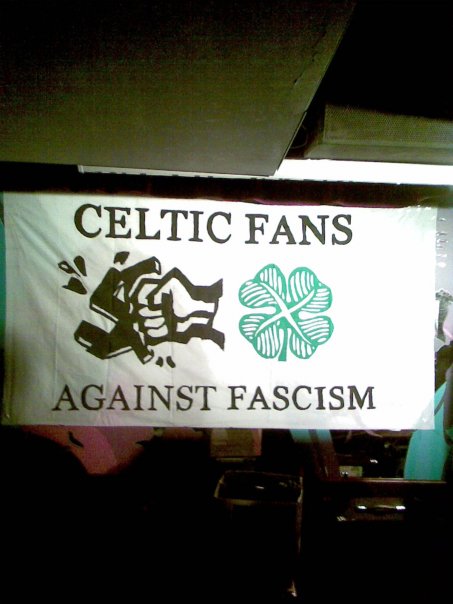
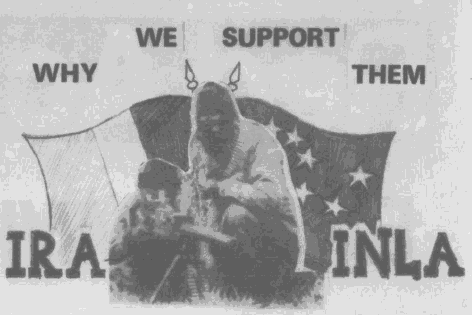
The lesson of “Celtic Fans Against Fascism” and Racism in Football – REPOST

The lesson of “Celtic Fans Against Fascism” and racism in football – a few thoughts.

Original Source: Football is Radical.

“The formation of TÁL and Celtic Fans Against Fascism was really the culmination of our reaction against the racism of our own supporters towards Rangers’ signing of the Black English player Mark Walters in the late 1980s.  In the first game that Walters played for Rangers at Celtic Park, many of our fans made monkey chants and threw bananas on to the trackside.  That day was one of the most depressing for the militant anti-fascists and republicans among our support…

The Irish in Scotland were themselves the victims of racism and discrimination.  Therefore, it was hypocritical, to say the least, for the second and third generation of that immigrant community to be the perpetrators of racism…

The most important aspect of all that period is that we won the political argument with the majority of fans as well as any physical confrontations with racists that resulted.  In the end, it really became “anti Celtic” to be a racist, with our fans now taking a pride in their progressive attitudes to politics and struggle.”

Excerpts from an interview with the editors of the TÁL Celtic fanzine, published in Class War in Winter 2007

This is by no means positing an answer to racism in football, but I thought the excerpt above is really interesting and useful in how we think about tackling racism as football fans and wanted to share some thoughts on it.

A really important part of this excerpt, to me, is that whilst it’s an encouraging piece about concrete anti-racist action at football in solidarity with immigrants, it also refuses to shy away from the fact that racism does exist in many football clubs – regardless of radical reputation.

When you love a football club with all the hypocrisies and split feelings that can conjure up, the first reaction is to be defensive when accusations of discrimination are levelled at a fan base.  You know that it isn’t representative of a whole fan base, but there can often (not always) be an illogical knee-jerk reaction based on loyalty.

Our club would never behave like that”.  ”It’s just a few idiots”.  ”You misheard what they were chanting.”

We’ve all heard, or maybe even made, those kind of excuses before.  As a result, it can be more convenient to ignore discrimination and save collective face rather than confront it and do something about it because of unswerving allegiance.

Reminded me of a sad time away at Millwall (I know they probably get more than their fair share of negative press so I’m not picking on them, this is just my experience) two seasons ago.  A man in the home support was openly doing monkey impressions and pointing at two black QPR fans a few rows ahead of us.  The desired victims of the abuse were livid and were held back by police and stewards as a load of us surged to the front in their defence.  One fan demanded the police do something about it – they said to “ignore it”.  From my privileged position of being a white football fan who’s never had to deal with that kind of abuse, what made it particularly fucked up to me was that the guy doing the monkey gestures was surrounded by fans who did nothing.  In front of kids, police, other fans.  He obviously felt that even completely on his own, he could behave like that in front of his own fans without any censure or retribution.  He was right, in that sense – no-one around him so much as batted an eyelid.  For the record, I have Millwall supporting friends who are all decent people who were as appalled as I was so it’s not a condemnation of the whole club and it’s support – but nonetheless, this whole incident went on with no interference from the home fans in that particular area.
Pointing out the irony of the pitch being sided with “Kick it Out” campaign boardings is a bit of a cheap shot, but it’s not surprising either.  Campaigns like this are well meaning but perhaps also foster complacency.  It’s something we can all point to and feel good about ourselves – and to some extent it is positive in that these kinds of campaigns normalise the idea of racist behaviour as abnormal, if not necessarily as unacceptable as it should be.  These campaigns rely on big gestures and the encouragement of fans to inform on others to the higher echelons of football.  Whilst this does occur sometimes, it is worthy of note that for better or worse, as a general rule, football fans do not tend to react positively to this approach.  The first thought in negative situations like this is not to run to the club or an anonymous phone line when things I do not agree with happen in the stands, and that’s the same for any other fan I’ve talked to about this kind of thing.  I’m not saying that isn’t a legitimate course of action, of course it can be – but from my experience, I wouldn’t say that notifying an FA campaign or the club direct is the first port of call for most supporters.

Why that may be is a whole debate in itself and there are many factors at play, and it isn’t something I can claim to answer.  In some sense it’s perhaps the idea that your club’s supporters are fundamentally “yours”.  I.e. you can disagree with some of them, be embarassed and offended by them, but they are still your supporters.  It’s maybe a bit like being at school – your mates may do something out of order, but in most cases, you’ll keep your mouth shut, even though you know it’s the wrong thing to do.  It doesn’t mean people do not do anything about it and don’t speak out or take action (although of course, this frequently is the case) – but fans don’t tend to go through the “official channels”.

For evidence of that, you only have to look at messageboards after violence between two clubs – both may have behaved as bad as eachother, but for all the condemnation of violence, there’s always that underlying subtext – “well yeah maybe some of our fans acted up, but we weren’t as bad as those animals from X club”.  Or how players seen as bastards one week become “your bastards” to many fans when they play for you.  The same people who booed Joey Barton or Marlon King or Lee Hughes etc. can be singing their praises when their shirt design changes.  We may try and ignore it but so often, club loyalty and fear of alienation of other supporters both play a role in how we tackle any issue in football and it shouldn’t be ignored.  It’s all well and good to say “I wouldn’t stand for this” if you’re radically inclined but football stands are, by their nature, a big mix of people and opinions. We should not underestimate the fact that many fans simply want to support their team, regardless of what is being said and done around them.

All too often, people will be offended but do nothing.  For fear of retribution from the person being discriminatory, or of “making a scene”, or just wanting to ignore it and get on with watching the game.  More fundamentally though, the perpetrators of discrimination are often as much “part” of the fanbase as you or I are.  It’s convenient for us all to shrug our shoulders and say they aren’t proper fans and be blasé about it because we and our friends aren’t the ones doing it.  They are in our stands, supporting our team and are therefore our problem.  You can’t just ignore it – the hate exists whether we turn our nose up at their fan status or not.  Whilst it might make us feel better, it certainly doesn’t address the problem and in some senses it makes it worse.  For example, for a football fan in England who is white, heterosexual and male (like me), doing nothing more than asserting my (assumed) non-discriminatory status as a ‘real fan’ is simply an expression of the privilege that discrimination rarely affects ‘people like me’.  It relegates racism to something far less serious.  It makes racism an issue of offending sensibilities and ‘fan status’ rather than a serious problem that breeds hate, excludes others and all too often leads to violence and persecution.

My point with this ramble, and that excerpt from the TÁL editors above, is that fundamentally anti racist action has to come from the fans themselves.  Celebrity, liberal anti racism campaigns do achieve a level of normalisation for not accepting racism, but it sits above the fans rather than being “of” the fans.  No different to the “Respect” campaign – well-meaning as these campaigns can be, it is telling supporters what to do, rather than supporters themselves deciding what is and is not acceptable in the stands.

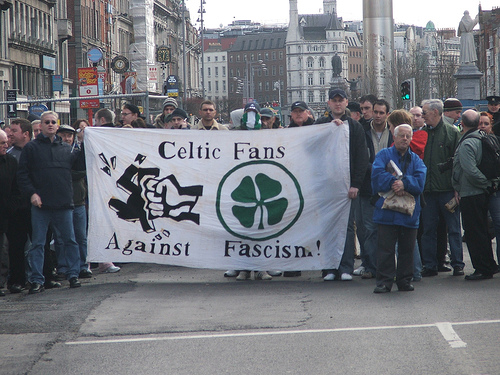
Celtic fans witnessed racism in their ranks and autonomously dealt with it – through dialogue with fans, through starting a fanzine to spread the word and through confronting racists en masse in and out of the stands to draw the line that racism is not acceptable.  Crucially, from within the fan base, not from UEFA, or the SFA or whatever – but from the people you share the stands with week in and week out.  

It’s an over-simplification of course, but fundamentally, a tannoy message and a celebrity telling a racist that monkey chants aren’t acceptable doesn’t make them sit down – it’s too external.  As well intentioned as “Kick it Out” is, it ignores the relationship with the fans – it’s being expressed by the same people who fuck with our kick off times, who allow sky high ticket prices, who instruct stewards to kick people out for standing and so on – the super structure of football.  You cannot safely predict that people who are reticent, angry or ambivalent about an FA mouthpiece most of the time to sit up and take notice of the same mouthpiece when it talks sense now and again.  Legitimate or otherwise, I know from myself that football supporters are not always the most logical – risking relationships and your job to lose your voice as you watch your team lose in the rain in Hartlepool is par for the course.  It’s not to say that fans don’t necessarily care – but an important campaign can be lost in a sea of complacency and routine.  Playing the same old recorded message about abuse from the stands can just fall into the same sonic landscape of a bad tannoy system telling you not to stand or that the match ball is sponsored by a local car showroom.  It gets lost in routine and people become detached from the message.  Anti racism ceases to be about active dissent – it falls helplessly into the audio and visual spectacle of detached fan compliance.  Fundamentally, whilst campaigns like Kick it Out could be better (perhaps with UEFA actually taking racism seriously, for starters), there is not much above that that they can do.  But a majority of fans drowning out such abuse, confronting it in numbers and winning the political argument from within the stands – that tends to be a different story.

We can’t be complacent and rely on liberal campaigns, the only way to really tackle racism is for fans themselves to take responsibility for what goes on in our stands.  When people hear something at the ground that offends them and feel too nervous to speak out (confrontations at the best of times can be very intimidating, and no less so at the football), all too often nothing but an awkward silence follows.  People may not realise that they are potentially surrounded by dozens of other people in earshot who feel just as offended – but just as intimidated.  But how would they know if we don’t talk about it?  That’s why, even if you don’t think your club has a problem, that talking about discrimination with your friends in the stands, on the messageboards, in the pub and so on, is so important.  When and if something like this happens, you can know that it’s not just you – but that other supporters feel just the same way and that can make the difference between keeping your mouth shut or standing up and doing something about it.  And that’s not just at your club – people may be over-zealous about the idea of “fan community”, but actions and words spread.  If you and your friends make a stand at one game, it can inspire other clubs to do it too.  Share your experiences online or pre/post match with fans of other clubs – you’ll be surprised just how many people are interested but felt too isolated and/or needed the inspiration to do something.

Drown it out with other chants, confront the perpetrator, boo – anything to make sure that the person realises that they are disgusting and offending their own fans.  People they may see every week and love the club just as much.  It’s a first step.  So don’t assume that everything’s ok – get talking and discussing!  Create a fanzine!  Make a banner with your friends!  And that means, me, you and anyone else who enjoys going to the football – because we are all responsible for our game.
 
See also:


Physical Resistance – A New Book on Anti-Fascism

A new book detailing anti-fascism in Britain over the last 100 years is due out on the 25th January 2013.

Physical Resistance: A Hundred Years of Anti-Fascism by Dave Hann (co-author of No Retreat) is a history of large-scale confrontations, disruption of meetings, sabotage and street fighting have been part of the practice of anti-fascism from the early twentieth century until the twenty-first. Rarely endorsed by any political party, the use of collective bodily strength remains a strategy of activists working in alliances and coalitions against fascism. In Physical Resistance famous battles against fascists, from the Olympia arena, Earls Court in 1934 and Cable Street in 1936 to Southall in 1978 and Bradford 2010, are told through the voices of participants. Anarchists, communists and socialists who belonged to a shifting series of anti-fascist organizations relate well-known events alongside many forgotten but significant episodes.


Combining scholarship with the knowledge that can only come from political experience this is a moving memorial to the late author and those who have fought fascism in Britain for almost a hundred years. Detailed accounts, eye witness testimony and a non-sectarian approach make this an engaging and fascinating account that should be read by activists and historians of all kinds. Dr Hilda Kean

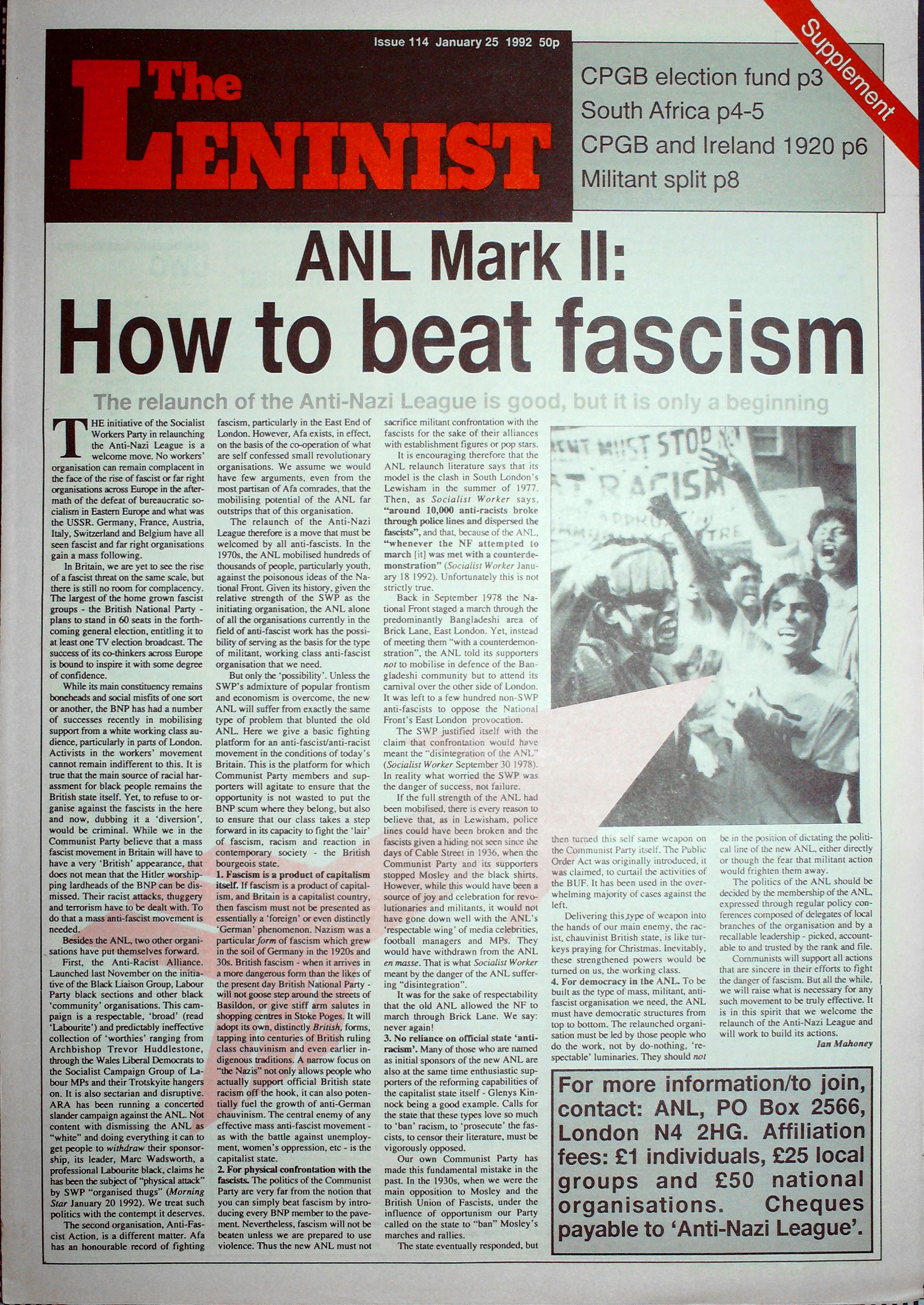
The Leninist – ANL Mark II: How to beat fascism

The back copies of The Leninist, the journal of the Communist Party of Great Britain and later the CPGB Provisional Central Committee, have been uploaded. Visit this site to view issue 1 through 116.

Issue 114 details the relaunch of the Anti-Nazi League by the Socialist Workers’ Party. The Leninist supports the new ANL over Anti-Fascist Action because they suspect it will be able to field more numbers. It does commend AFA for its work and calls for a continuation of the physical confrontation of fascists.

Download the whole newspaper here. 

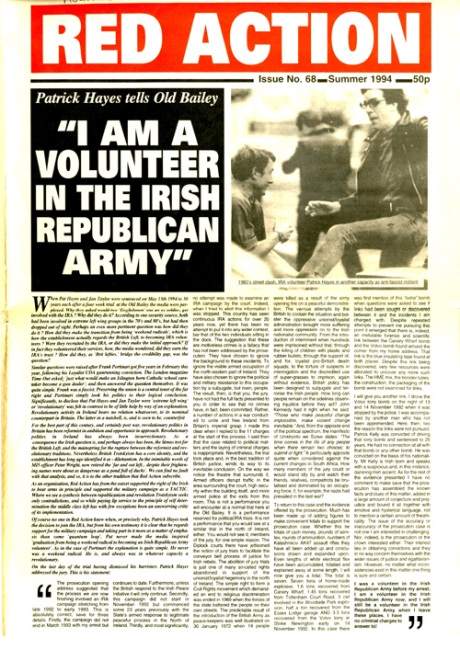
Left Archive: Red Action, Issue No. 68, Summer 1994 – REPOST

The following article is a re-post from Cedar Lounge Revolution

To download the above file please click on the following link: REDACTION

Recently Red Action posted much of their archive online, and this can be accessed here. That includes the above document, but since this was already acquired for the Archive and scanned in it seemed appropriate to include at least one example of the output of the formation (and as it happens we’ve been promised some more documents in the future with a specifically Irish orientation).

Red Action appeared in 1981 when members were expelled from the Socialist Workers Party for squadist activities. Consequently in outlook it positioned itself as an self-avowedly forceful response to the threat of fascism and racism as well as cleaving to a strongly working class centred position. In the 1980s it joined the RCP led Red Front (as can be seen in this document from the RCP in the Archive). Interestingly it transitioned into community based politics in the late 1990s and on into the 2000s, and former members were heavily involved in the Independent Working Class Association which went on to win council seats and only relatively recently became inoperative.

This document is of particular interest because while it demonstrates all the political approaches outlined above it furthermore relates to one key aspect of Red Action, that being an strong identification with Irish Republicanism – it is notable that in other documents available on the Red Action site Thomas ‘Ta’ Power of the IRSP, later assassinated by the IPLO, is quoted. The cover story notes that Patrick Hayes, an English born member of a PIRA active service unit, imprisoned for a short bombing campaign in England in the early 1990s, was a former long standing member of Red Action (for more on this see this from the UK Independent which gives a subjective but interesting overview).

As the editorial accompanying Haye’s statement at the Old Bailey on his imprisonment notes:

As an organisation, Red Action has from the outset supported the right of the Irish to bear arms in principle and supported the military campaign as a TACTIC. Where we see a synthesis between republicanism and revolution Trotskyism seeks only contradictions, and so while paying lip service to the principle of self-determination the middle class left has with a few exceptions been an unswerving critic of its implementation.

It continues:

Of course no one in Red Action knew when, or precisely why, Patrick Hayes took the decision to join the IRA, but from his own testimony it is clear that he regards support for the military campaign and taking part in it more a matter of emphasis than some ‘quantum leap’. Pat never made the media inspired ‘graduation from being a weekend radical to becoming an IRA volunteer’. As in the case of Portinari [a Loyalist gunrunner] the explanation is quite simple. He never was a weekend radical. He is, and always was in whatever capacity a revolutionary.

In some respects these quotes also offer an insight into other aspects of Red Action, namely a strongly critical view of other contemporary further left formations, particularly those with a Trotskyist orientation – albeit it itself came from a Trotskyist heritage. It also held a strongly working class position that saw itself as deeply at odds with the middle class both in class and political forms or in its analysis that other further left formations were distorted by that class.

This combative stance is exemplified by a number of articles in the document on Trotskyism, including ‘Trotskyism’ with No Illusions which lambastes both the British Labour Party and ‘the Trotskyite Left [who] without exception line up with the bureaucracy in defence of the status quo, [whereas] we stand with the working class against the bureaucracy’ and within the working class; with the anti-racists against the racists.’. There is also an article which takes as its starting point the then recently published final edition of the SWP’s Tony Cliff’s final volume of his biography of Trotsky which is sub-titled ‘The Real History of the Fourth International’.

The emphasis on Irish Republicanism is evidenced throughout the text with highly critical articles on the Troops Out movement (and which is also in passing highly critical of the RCP) and a page devoted to “Dispatches from a war zone” and which in this instance dealswith informers and pro-British agents.


There’s also a piece under the heading ‘Beyond the Pale’ for Red Action in Ireland, complete with PO Box. The accompanying article, ‘Guns, Drugs & The Community’, outlines the history of the development of the drugs issue in working class Dublin and how Concerned Parents Against Drugs (CPAD) became pivotal in ‘the fight against drugs’. The article notes that ‘The Left’s attitude to this genuine instance of working class people taking control of their lives has also been pathetic. From the SWM’s denunciation of CPAD as vigilantes, to the serious serious damage done to the anti-drugs campaign by the Workers’ Party’s allegations of addicts being kept against their will in France, the left in Dublin has been a hindrance to the CPAD. Sinn Féin are the only group on the left who can claim any credibility from the fight against the drug pushers. Contrary to the allegations of SF infiltration of CPAD, the SF activists actually belonged to the working class communities under threat and had every right ton involve themselves in the fight against drugs’.

In the latter there is the following reference: CPAD wants addicts to be sent to treatment centres where they might actually have a chance to get off drugs. CPAD have in the past sent addicts to the Le Patriarche centre in France but a Workers Party created controversy and lack of resources meant this could not be continued’.


Archivist: there are also some interesting comments on the original post which are worth reading.


See also: The Arrest of Patrick Hayes

Interesting article from the Irish Anarchist History Archive.

Irish Anarchist History Archive's avataririshanarchisthistory

In the summer of 1985 readers of the daily Cork Examiner saw a debate between Kevin Doyle of the Workers Solidarity Movement and Matt Doolan, a regular guest on RTE’s The Late Late Show.  (Unknown to most RTE viewers, Doolan had been a prominent member of the Blueshirt fascist movement in the 1930s.)

click here to download

The reference to Ballinspittle in Doyle’s second letter refers to the hysteria which swept through the little rural Cork village that year when dozens of Catholics claimed to have seen a statue of the Blessed Virgin Mary moving spontaneously (though never in front of a camera!)

View original post

The Hook (Manchester Docks Rank and File Bulletin)

This post contains copies of The Shipcanal and The Hook a left-wing rank and file workers’ bulletin of the Salford Docks.

They have given to me by my grandfather and as they are not available online anywhere else, here they are! Now they’ve been uploaded I intend to give them to the Working Class Movement Library in Salford.

Issue One of The Ship Canal – shipcanal1

Issue Two of The Ship Canal – shipcanal2

Issue Four of The Ship Canal – shipcanal4

Issue Five of The Ship Canal – shipcanal5

Issue One  (1971)

Contents:

  1. May 14th Strike Action
  2. Job losses on the docks
  3. Wage reductions on the docks
  4. Container Boats
  5. More Jobs losses
  6. Strike at Klein Bros in Salford

Issue Six (1974?)

Contents:

  1. Nationalisation of the ports
  2. Christian Barnard
  3. Bristol Committee and Containerisation
  4. Industrial Relations Bill – TUC Retreat
  5. Frinkville Massacre and Vietnam War
  6. Containerisation
  7. Dock Labour Scheme under attack


Issue Ten

Contents:

  1. Fight for a £37.50 wage
  2. Liverpool Dockers Union gets 100% control of hiring
  3. Defend The Ship Canal newspaper
  4. Modernisation and deconstruction of the Manchester dock
  5. History of the Dockers’ Union and why there are two trade unions representing dockers
  6. Joe Hill
  7. National Conference of Dock Shop Stewards
  8. Liverpool lead the way!


The Hook Issue 13 thehook13

The Hook Issue 14 thehook14

The Hook Issue 15 thehook15

The Hook Issue 16 thehook16

The Hook Issue 17 thehook17

Update 16

Small update but an important update in the world of anti-fascist archiving؟

Firstly, the Red Action Archives are now online. An enormously interesting and important website. Check it out and trawl through it!

Secondly, a huge thanks, again, to SM who has provided a large number of academic articles on fascism and anti-fascism. The subjects include: National Socialist Black Metal, fascism and anti-fascism in the USA, Germany, Portugal, Italy and Huddersfield; the politics of punks and unionism in the United States.

Next on the list is a Workers’ Fight pamphlet published in 1972: Racialism and the Working Class.

I have also uploaded three Red Action Bulletins.

Lastly, I have also written a review of the AFA Ireland pamphletUndertones.

I can give you some lovely statistics though! Firstly, having hit 50,000 views, I have a monthly breakdown of views and, next, a map of countries which have viewed the Archive.


Red Action Archive

The Red Action Archive is here!!!

It’s been a long wait but it looks like its been worth it. The archive contains the entire back catalogue of Red Action newspapers and bulletins, plus material on anti-fascism, Ireland and drugs.

A history of Red Action has been written too: The Road Less Travelled: The History of Red Action

Big thank you to those who have taken the time and effort to get the archive online.

Link to Archive

Racialism and the Working Class – Workers Fight Pamphlet

This is a Workers Fight, a forerunner to the Alliance for Workers Liberty, pamphlet published in 1972 (?). It is a collection of articles, the first one  seems to be written in response to Enoch Powell’s infamous 1968 ‘Rivers of Blood’ speech.

Contents:

  1. No room for racism
  2. Racialism and the working class
  3. Colonialism and the roots of racialism
  4. The past and present of the white man as cannibal
  5. Victims of  a racialism education
  6. Black workers and the law
  7. The fascist infiltration in the trade unions

Download: Racialism and the Working Class