Glasgow Anti-Fascist Action

This post will contain material from Glasgow Anti-Fascist Action.


Above: The first leaflet put out by Glasgow Anti-Fascists around 1989/90. GAF was the forerunner to the Anti-Fascist Action (AFA) branch in the city.


  • Glasgow AFA: a leaflet about who they are and what they do.
  • Glasgow AFA leaflet for a public meeting regarding a rise in racist and fascist activity.
  • Glasgow AFA leaflet for another public meeting regarding racist attacks.

Edinburgh Anti-Fascist Action

This post will contain material from Edinburgh AFA.


  • Anti-Fascist Action: leaflet detailing who Edinburgh AFA are and their aims.
  • Anti-Fascist Action: another leaflet detailing who Edinburgh AFA are and their aims.
  • Edinburgh AFA Press Release regarding a No Remorse convert which was cancelled because of EAFA’s activity.
  • EAFA’s poster for a public meeting with German anti-fascists

Birmingham Anti-Fascists

This post will list material from Birmingham Anti-Fascist Action/Alliance.

  • Public Statement (12/07/94): Brimingham Anti-Fascist Action resigns from Anti-Fascist Action and becomes the Birmingham Anti-Fascist Alliance. This statement details the reasons why.
  • Organisation Mailing (08/94): BAFA write to Edinburgh AFA following their resignation.
  • Fighting Fascism #4 (Summer 1994): BAFA’s newsletter of Birmingham.

Rituals of Remembrance and Protest.

It’s 11.00 on the 11th November as I start writing this.  The campus has just slipped into observing a two-minute silence to mark Armistice Day and I’ve slipped into the silent rage that these celebrations of imperialist slaughter always provoke in me.  To shift my mood a little, I remember instead two rituals of remembrance that I associate with the Non-Stop Picket of the South African Embassy back in the 1980s.

Remembrance Sunday was always a tense day on the Non-Stop Picket.  Situated in Trafalgar Square it was less than a mile away from the Cenotaph on Whitehall, the focus for state rituals of remembrance.  Sometimes the hordes of passing former servicemen and women passing the Picket on their way to or from the ceremony at the Cenotaph could be antagonistic towards the anti-apartheid cause (although that was not universally the case).  Those retired soldiers were never the real problem, though. The threat posed to the Non-Stop Picket on Remembrance Sunday was the annual parade passed the Cenotaph later in the day by the motley membership of the neo-fascist National Front and/or British National Party.  They definitely didn’t like anti-racists protesting against apartheid, and had a tendency to either try to launch full on assaults against the Picket or, more ‘subtly’, attempt to provoke violent arguments with picketers.  In response, each year on Remembrance Sunday large numbers of City Group supporters and other anti-fascists would mobilise and gather on the Non-Stop Picket to defend it against potential attack.  On 13th November 1988 in particular, hundreds gathered outside the Embassy in response to heightened fear of fascist attack.  In parallel to these mobilizations, activists from the Non-Stop Picket would often patrol the area with Anti-Fascist Action to spot and head off groups of fascists heading towards the Picket.

These anti-fascist mobilizations to defend the safety and integrity of the Non-Stop Picket once again highlight the ways in which, for the members of the City of London Anti-Apartheid Group, the politics of anti-apartheid solidarity activism could never be separated from anti-racist and anti-fascist work in Britain.

Weaving flowers into the Embassy Gates, Summer 1986 (Source: author)

There is one further way in which I want to remember rituals of remembrance associated with the Non-Stop Picket.  That is to consider the ritual practices that City Group developed to remember those freedom fighters killed by the apartheid regime.  When apartheid prisoners were executed, anti-apartheid activists were assassinated by South African agents, or the South African Defence Force (sic) massacred youth in the townships, City Group would respond to witness that act of state violence.  Very often this involved a ritual of placing flowers on the imposing, monumental gates of South Africa House.  Sometimes this would be a modest and spontaneous act by the protestors gathered on the Picket for a particular shift, but during the weekly Friday night rallies or other large gatherings, a dignified queue would form as scores of protestors waited to add their flowers to the Embassy gates until they were bedecked in  flowers of remembrance.  More often than not, the picketers would sustain the haunting melody of Senzenina, a song sung at political funerals in South Africa, throughout this act of witness, mourning and remembrance.

If poppy-wearing and the official two-minute silences of Armistice Day and Remembrance Sunday serve as nationalistic rituals that reproduce public support for continued military intervention around the world through the remembrance the fallen soldiers of past wars; then, the laying of flowers on the gates of the South African Embassy and the singing of Senzenina renewed the commitment of the picketers to stand in solidarity with those resisting apartheid in southern Africa.

This article is from the fantastic Non-Stop Against Apartheid blog.
Red Action: Various Literature

This post will list various literature from Red Action.


IWCA Literature

This post will list literature from the Independent Working Class Association.

  • IWCA Letter (1996): this letter is in reply to subscription and support to the IWCA.
  • IWCA Letter (1996): this letter is in reply to interest in joining the IWCA.
  • IWCA Letter (1996): this is a letter regarding a meeting in Glasgow.
  • IWCA Whalley Range leaflet: newsletter discussing the election of New Labour and the local battle against a mobile phone mast.

Also see the IWCA’s Filling the Vacuum document.

BtF Picture Scandal

The publishers of Beating the Fascists, Freedom Press, have got into hot water regarding the cover picture used on the book. Whilst this post isn’t strictly about the history of AFA, I think it warrants a post on this archive.

Now that we’re bust and what we’re going to do about it

As many comrades are aware, Freedom has continued thanks to a significant donation in 2005. This not only enabled us to keep the paper going, but also to publish large print runs of important anarchist classics and undertake work to the building such as moving the shop downstairs. It has also meant that we have been able to pay people (albeit at very low rates) who are doing work which prevents them getting gainful employment elsewhere. This has enabled the political transformation of Freedom Press from a group with a particular viewpoint within anarchism to a resource responsible to the broad movement. We don’t want to return to a situation where Freedom is run simply by those with spare time or money who then determine its politics.

While we can’t have an ideal accountable structure (the undercover cop federation would end up in charge) the Freedom collective includes comrades from The Anarchist Federation, The Solidarity Federation, Corporate Watch, Anarchist Black Cross, Liberty and Solidarity, Advisory Service for Squatters, Action East End, Anti Fascist Network, Legal Defence and Monitoring Group as well as non-aligned comrades – be fair you can’t expect Donald to set up a new group at 84.

However, the 2005 donation has now run out. This is not unexpected of itself, but it has happened sooner than we anticipated because of the Beating the Fascists photograph saga. When we published this book in 2009 it was illustrated with photographs supplied by the authors. Unbeknown to us, these included pictures taken by David Hoffman which were still under copyright. We have ended up paying him £4,000 for the use of these pictures rather than face legal action. While this was a stupid mistake by us, it’s very disappointing that someone who claims to support anti-fascist politics and made money from their photographs, while enjoying protection from the far right on demonstrations, should chose to extract money from a radical publisher for a genuine mistake. The result is that we have had to reconsider the future far sooner than we thought.

We will still be able to carry on at 84b with the shop and distributing books and, of course, all the offices, meetings and other activities in the building. However we are going to look seriously at continuing producing a hard-copy paper. Freedom is (and for a long time has been the only) regular paper of the anarchist movement in this country, yet the number of subscribers (around 300) and groups/individuals distributing it (about 10) is tiny. The exact size of the anarchist movement is known only to the Box and the Branch, but given that the London Anarchist Bookfair attracts around 3,000 people, they can’t all be undercovers. Thus we know only a minority want to read and an insignificant minority distribute Freedom. This could be because printed newspapers have had their day as a form of propaganda, or it could be the paper’s rubbish. Nothing we can do about the former, but fixing the latter will be down to more comrades writing better stuff. However before considering shutting the paper down we want to explore the possibility that the majority of the movement simply haven’t considered the possibilities of using Freedom to spread the anarchist message. Even if comrades don’t want to spread the anarchist message, they can at least make a few bob selling it. Freedom is printed for free by Aldgate Press out of their historic loyalty to the movement. However we still have to pay for layout and folding, admin and postage. Subscriptions would need to rise to around 500 to break even, or raise the UK subscription to £36. It seems a shame to give up such a resource as free printing for the movement, so if we discontinued the hard copy of the paper we would ask Aldgate if they would be prepared to do any other stuff either free or discounted.

In reality. The only test that we can do to decide whether to continue with the paper is to see if there is practical support in the movement for it. This has two elements. Financially, at the current level of subscriptions we would need £4,000 in donations a year to keep the paper going. Obviously there are many good causes competing for comrades’ money and if you or your group think that the cash should be spent on other projects then that’s well and good. More significantly, does the anarchist movement think that producing and distributing Freedom is beneficial to the anarchist cause and is it prepared to do so. If the situation remains as it is now we will end the hard copy version in October on its 125th Anniversary and put out some guff about it transforming into a digital entity for the online age.

Appeal and public meeting at the Bookfair

Hence we are launching an appeal for donations towards keeping the paper going and to get more people to take the paper on sale or return. We will keep comrades informed both in print and on the website how it’s going. We are having a meeting at the London Anarchist Bookfair so comrades have a chance to discuss the future of the paper face to face.

This article appears in the July 2012 issue of Freedom.

Source

International Anti-Fascist Conference

In 1997 Anti-Fascist Action organised an international militant anti-fascist conference. However, owing to pressure from Camden Council, Camden Irish Centre cancelled the booking last minute. Fortunately, AFA was able to pull off the conference despite the hitch.

A special Fighting Talk pamphlet was also produced. View it here thanks to DC.

Here are some newspaper articles about the Irish Centre cancelling the event.

  1. Anti-Fascists Booted out of Irish Centre (The Irish World, 3 Oct 1997)
  2. Irish Centre bans Anti-Fascist Rally (Irish Post, 4 Oct 1997)
  3. Double Standards over AFA (The Irish World, 3 Oct 1997)
  4. Anti-Fascists Banned from Irish Centre (Associated Press, 9 Oct 1997)
  5. Exclusive (The Irish World, 10 Oct 1997)
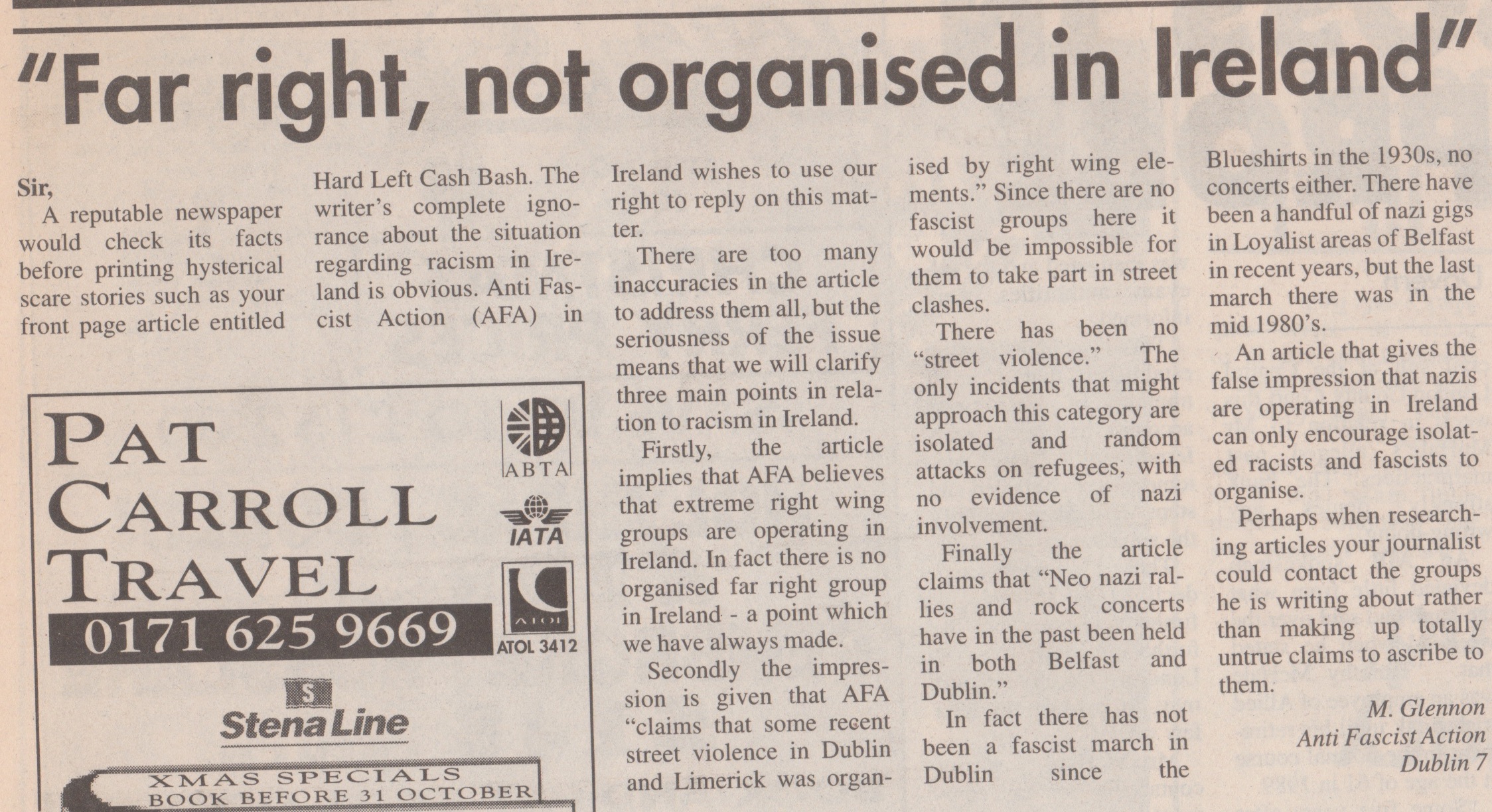
  6. “Far right, not organised in Ireland” (Letter from Dublin AFA to The Irish World, 10 Oct 1997)
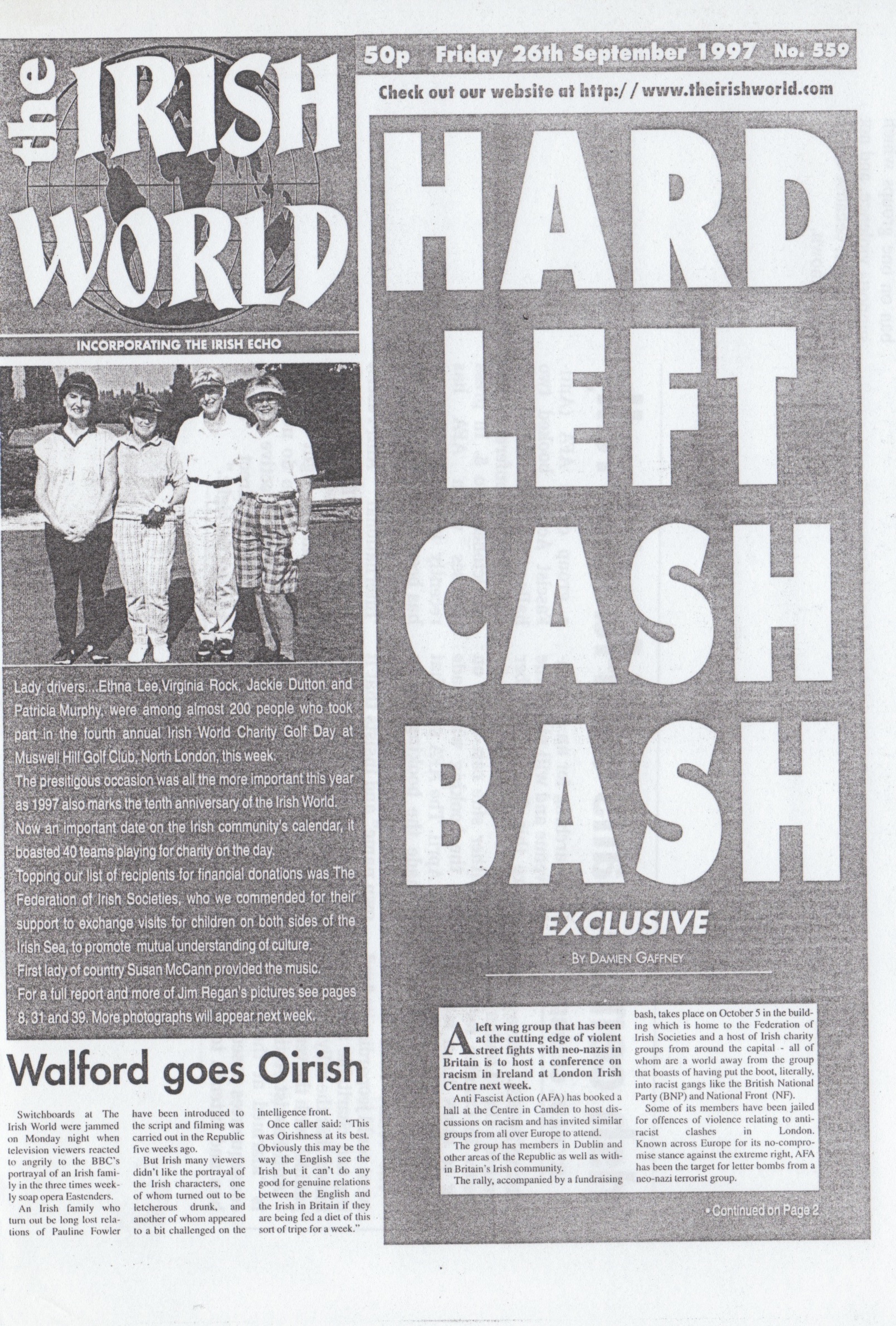
  7. Hard Left Cash Bash (The Irish World, 26 Sept 1997)
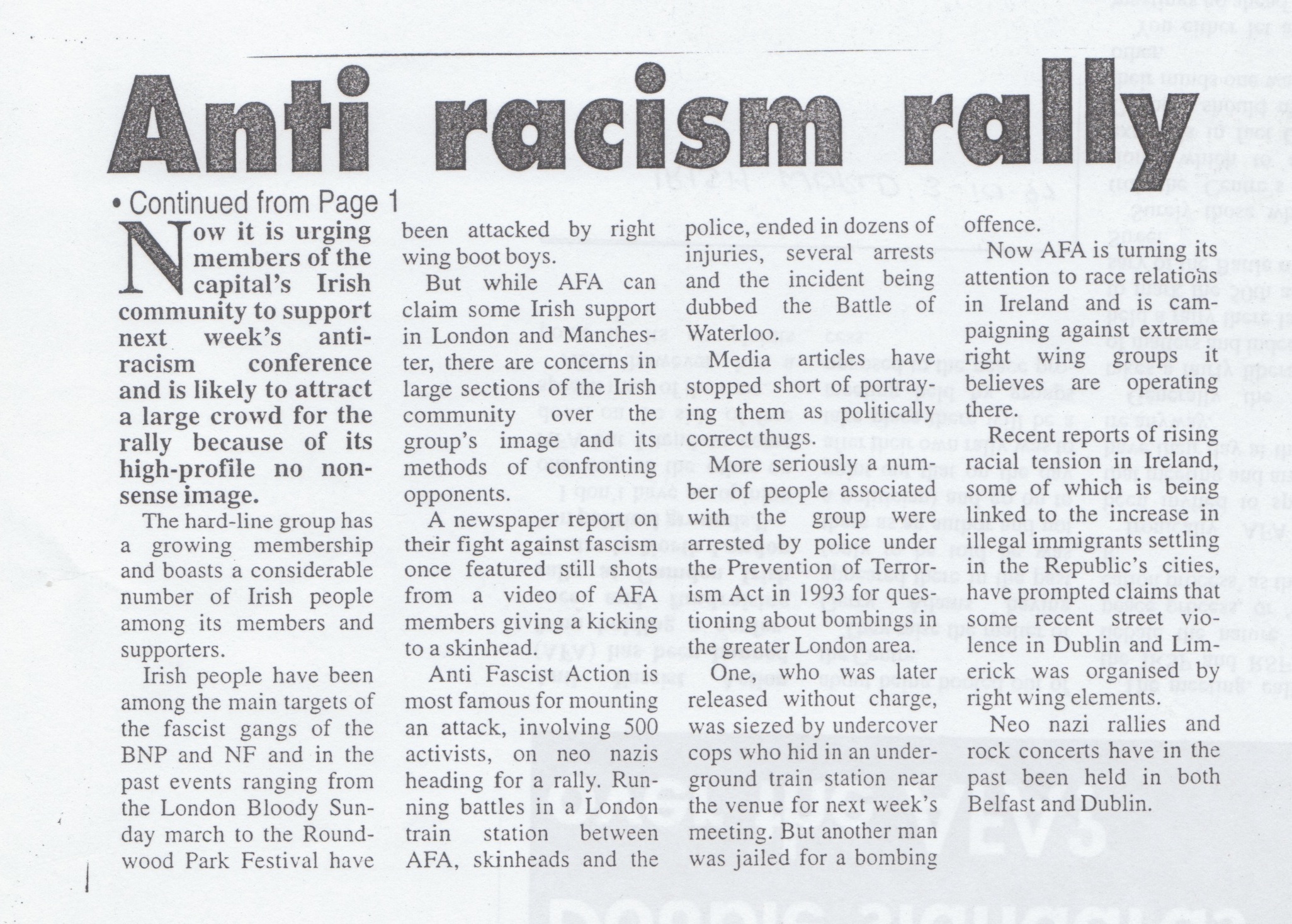
  8. Anti-Racism Rally (The Irish World, 26 Sept 1997)

A report from the conference by a Seattle based group can be found here.

Thanks to SM for this contribution.

Leaflets

This post will feature anti-fascist leaflets. It will be updated repeated, so check the weekly updates for changes to it!

  1. C-18: Back to Basics (AFA, 1994)
  2. Celtic Anti-Fascists (Celtic AF, 1995)
  3. Time for Change? What Supporting the BNP Means for You (AFA, 1992-1994?)
  4. Nothing to Lose but your Lollipops (AFA, 1994) 
  5. Pat Crerend He’s Yer Man! (Red Attitude suppliment, ?)
  6. Red Action Manchester Bulletin #9 (Red Action, 1994)
  7. The Independent Working Class Association (IWCA, 1995?)
  8. Tories in Flight Jackets (AFA, 1995-1997?)
  9. Whats the Best Way to beat the Fascists? The Working Class, Anti-Fascism and the SWP. (Red Action, 1991-1992?)
  10. John Hamilton: Wanted Dead!
  11. AFA leaflet on Saranjit Singh’s murder (1988)
  12. Stop the BNP: Tyndall By-Election AFA leaflet
  13. London AFA leaflet on the Jailing of 3 Anti-Fascists
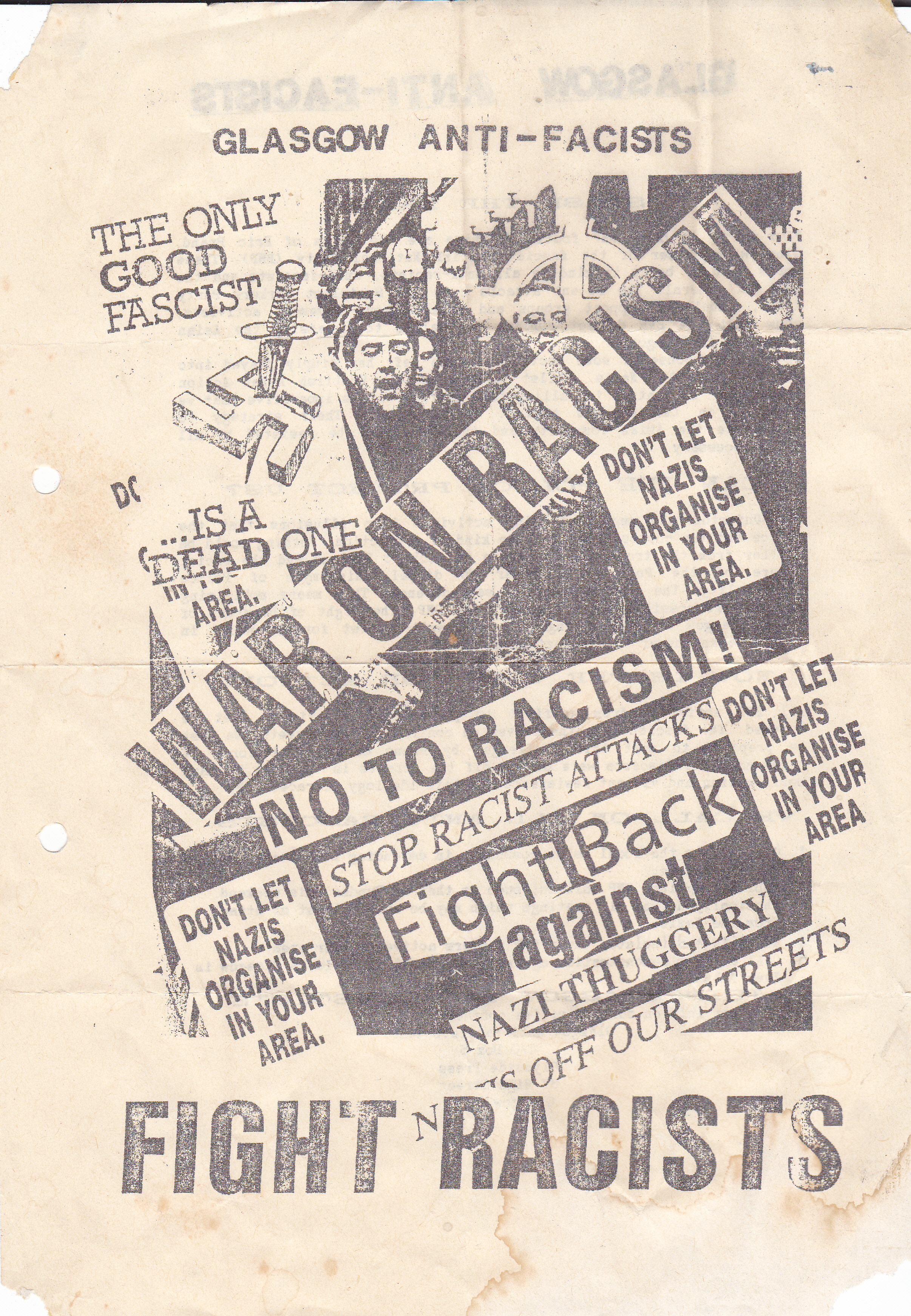
  14. AFA poster: The Only Good Fascists is a Dead Fascist
  15. Freedom of Movement poster. 

Thanks to SM for 1-9!!!
Thanks to ST for 10!
Thanks to for 11-15!!

Academic Works and Articles

This will be a list of academic studies which will be of interest to those wanting to study militant anti-fascism.

If you have written an essay which is of good quality or contains original research please email: antifascistarchive@gmail.com.

Essays not written by academics

On the Principles of Political Violence and the Case of Anti-Fascist Action (The Archivist, 2012)

“Taking It Back, Making It Strong!”: The Boundary Establishment And Maintenance Practices Of A Montréal Anti-Racist Skinhead Gang

The National Front and British National Party on Merseyside. A Geography of Political Extremism

Blackshirts in Red Scotland: an analysis of fascism and its opponents in inter-war Scotland

Articles on Anti-Fascism
1920-1945

Communists and the Inter-War Anti-Fascist Struggle in the United States and Britain (Copsey, 2011)

Anti-Fascist Activity in Manchester’s Jewish Community (Gewirtz)

1946 – 1959

“Class Before Race”: British Communism and the Place of Empire in Postwar Race Relations (Smith, 2008)

1960 – 1979

Conflicting Narratives of Black Youth Rebellion in Modern Britain (Smith)

A Bulwark Diminished: The Communist Party, the SWP and anti-fascism in the 1970s. (Smith)

Bridging the Gap: The British Communist Party and the limits of the state in tackling racism (Smith)

Are the Kids United? The Communist Party of Great Britain, Rock Against Racism and the Politics of Youth Culture (Smith)

1968 – Too Little and Too Late? The Communist Party and Race Relations in the Late 1960s (Smith, 2008)

When the Party Comes Down: The CPGB and Youth Culture, 1976-1991 (Smith)

Witness Seminar: Anti-Fascism in 1970s Huddersfield (2006)

1980 – date

Anti-Fascist Action: Radical Resistance or Rent-a-Mob? (Hayes and Alyward, 2000)

Marching Altogether? Football fans taking a stand against racism (Thomas, 2010)

When the Whites When Marching In: Racism and Resistance in English Football (Greenfield and Osborn, 1996)

Glasgow Celtic Fans, Political Culture and the Tiocfaidh Ar La Fanzine: Some Comments and a Content Analysis (Hayes, 2006)

The Limits of National Memory: Anti-Fascism, The Holocaust and the Fosse Ardeatine Memorial in 1990s Italy (Clifford, 2008)

Neo-Nazism, Holocaust Denial and UK Law (Cohn-Sherbok, 2010)

Choosing Social Justice over Hate Two Stories of Community Success in the Pacific Northwest (Stewart, 2010)

The Politics and Culture of FC St. Pauli: from leftism, through antiestablishment, to commercialization (Petra Daniel & Christos Kassimeris, 2013)

‘The birthplace of Italian communism’: political identity and action amongst livorno fans (Doidge, 2013)

Contesting the ‘authentic’ community: Far-right spatial strategy and everyday responses in an era of crisis (Ince, 2011)

Articles on Fascism
1920-1945

The Swastika and the Shamrock: British Fascism and the Irish Question, 1918-1940 (Douglas, 1997)

Opposition to the New Party: an incipient anti-fascism or a defence against ‘Mosleyitis’? (Copsey, 2009)

“Apostles of Fascism,” “Communist Clergy,” and the UAW: Political Ideology and Working-Class Religion in Detroit, 1919–1945 (Pehl, 2012)

1946-1959
1960-1979

Ulster Unionists in America, 1972-1985 (Wilson, 2007)

Shot By Both Sides: Punk, Politics and the End of ‘Consensus’ (Worley, 2012)

1980 – date

Patterns of Racism: Interviews with National Front Members (Billig, 1978)

Extreme music for extreme people? Norwegian black metal and transcendent violence (Phillipov, 2011)

Voice of our blood: National Socialist discourses in black metal (Olson, 2011)

Continental Divide: Immigration and the New European Right (Rosenthal, 2011) 

Visions of Hate: Explaining Neo-Nazi Violence in the Russian Federation (Arnold, 2010)

Anti-Zionism and the Italian Extreme Right (Chiarini, 2008)

Right-Extremism in Germany: Recruitment of New Members (Braunthal, 2008)

At the Roots of the New Right-Wing Extremism in Portugal: The National Action Movement, 1985-1991 (Marchi, 2010)

Australian Fascism? A Revisionist Analysis of the Ideology of the New Guard (Cunningham, 2012)

Colin Jordan’s ‘Merrie England’ and ‘Universal Nazism’ (Jackson, 2011)

The EDL: Britain’s New Far Right Social Movement (Jackson, 2011)

Negotiating White Power Activist Stigma (Simi, 2009)

The Nationalist Party of America: Right-Wing Activism and Billy Roper’s White Revolution (Dentice, 2011)

Computer-Mediated False Consensus: Radical Online Groups, Social Networks and News Media (Wojcieszak, 2011)