Leeds Fans United Against Racism and Fascism produced the fanzine Marching Altogether. Here are a few issues:
For more on anti-fascism in Leeds see the “Leeds Tag”
Interesting article from Big Issue North. Evidence that a police spy, Jenner, infiltrated AFA.
—————-
I now know the name of the Metropolitan Police officer who was employed to spy on the protest group in which I was one of the key organisers in the 1990s. Thanks to his former partner Alison (not her real name) and the Guardian it has been established that the man I knew during my time at the Colin Roach Centre (CRC) in Hackney as Mark Cassidy is Mark Jenner of the Met’s special demonstration squad (SDS).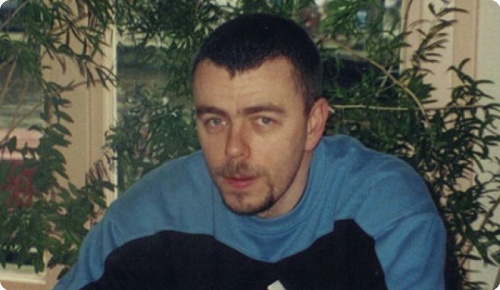
Jenner’s name was revealed when Alison gave evidence to the Home Affairs Select Committee inquiry into undercover policing, his police role confirmed by the Guardian on 1 March. He is one of 11 undercover police officers publicly identified. Nine of them had sexual relations with activists mainly from environmental groups.
The officers’ actions began unravelling in 2011 when the Crown Prosecution Service (CPS) dropped criminal proceedings against six people facing charges related to a conspiracy to sabotage a coal-fired power station at Ratcliffe-on-Soar, Nottinghamshire. The convictions of another 20 activists were later quashed after it was revealed that long-term police spy PC Mark Kennedy had acted as an agent provocateur within the environmental movement. Further allegations of undercover police officers acting beyond their authorisation then surfaced and we now know they were given the names of infants who had died many years previously.
The Metropolitan Police has now been ordered to investigate under Operation Herne how SDS officers created and maintained false identities while undercover.
After Kennedy became public knowledge I wrote a piece for The Big Issue in the North in January 2011 about the man I knew then as Cassidy. Although I had worked Jenner out many years beforehand it was only after he had been active in high profile campaigns in which members of CRC were involved. The centre was opened in 1993 and named after a young black man shot dead inside Stoke Newington Police Station in 1983. It combined a number of unfunded local groups, including the Hackney Community Defence Organisation (HCDA), which had uncovered serious corruption amongst the local police, with Panorama and World in Action undercover investigations confirming some officers were involved in drug dealing.
CRC was burgled, with equipment vandalised and a computer stolen. Cash was left undisturbed
HCDA’s work overturned many convictions and a database of police officers known to have complaints or convictions against them was compiled. The Defendants Information Services (DIS) was registered despite objections from the Association of Chief Police Officers. On 23 December 1994, a day when HCDA had organised a picket of Stoke Newington Police Station to demand action over the death of Oluwasijibomo Lapite in police custody, CRC was burgled, with equipment vandalised and a computer stolen. Cash was left undisturbed. An HCDA spokesperson told the Hackney Gazette: “It was the work of Special Branch, whose real target was a new database service.” In fact DIS was run from a different location.
Early the following year a Liverpudlian who identified himself as Mark Cassidy came into the centre to say he had seen TV coverage of the annual commemoration event for those who had died at the hands of the local police. The 1995 guest speaker was civil rights lawyer Gareth Pierce.“Cassidy” quickly became active in most of the centre’s political life, including writing for our internal bulletin. When a magazine sold to the public was launched his suggestion to call it RPM – revolutions per minute – was agreed. He attended members’ meetings and was privy to confidential information on hundreds of people’s policing cases, including where police officers were charged with unlawful imprisonment and conspiracy to pervert the course of justice.
Jenner was privy to confidential information on hundreds of people’s policing cases
Graham Smith, a Manchester University lecturer, consultant on police complaints to the Council of Europe Commissioner for Human Rights and an international expert on police accountability, says: “I am concerned that undercover officer Mark Jenner participated in an organisation that supported law abiding citizens who were involved in legal proceedings against the Metropolitan Police.”
CRC, with Jenner much involved, was also central to the campaign by businessman Malcolm Kennedy to prove he had not killed Patrick Quinn in 1990. Quinn had been battered to death – his injuries included 33 fractured ribs – in Hammersmith Police Station. Convicted of murder, Kennedy was released after his conviction was quashed when the World in Action programme, uncovered new witnesses in the police station, giving grounds for appeal.
At his retrial Kennedy was cleared of murder but convicted of manslaughter. After receiving the backing of 65 MPs when a parliamentary motion supporting him was tabled he was granted further leave to appeal. Kennedy lost his appeal in 1996 but as a free man he has continued to campaign to have his conviction overturned. He alleges that as a result he has suffered constant harassment by the police, making it almost impossible for him to earn a living from his removals business.
“This may have perverted the course of justice.”
Kennedy says: “I find it eerie that Jenner was involved at the CRC during the period of my 1996 appeal when he was privy to campaign strategies and confidential information. This may have perverted the course of justice. Without a proper investigation there is no way of knowing how much damage Jenner caused to me.”
Claiming to be a building worker himself, Jenner supported others victimised by their construction industry employers. The Building Workers Group (BWG) had decided to put pickets on workplaces where deaths had occurred. Three people a week were being killed on UK building sites and the aim was to damage the employers’ profits and force them to take action to prevent such tragedies. Where workers refused to cross a picket line it was maintained. However, where the majority went to work the others were persuaded to join them in order to prevent victimisation.
The initiative was a direct challenge to anti-trade union laws. Jenner attended picket lines, wrote for the BWG newspaper and came into contact with many union site representatives.
When UCATT officer Dominic Hehir sued BWG and union member Brian Higgins for libel over allegations he was failing to support members, a defence campaign was established – and Jenner became the chair. Although the campaign was successful the time taken up on Higgins’ defence meant there was little in reserve to picket sites. Those involved felt it was a hollow victory. Higgins, a blacklisted building worker, says: “I am appalled to discover ‘Mark Cassidy’ was actually an undercover police officer who used his cover as a building worker to infiltrate organisations the state does not like. It is like some Orwellian nightmare and it is surely time for decency, justice and democracy for blacklisted workers.”
Higgins is one of 3,213 building workers’ names on the Consulting Association (CA) database used by 44 building companies to vet potential new recruits over the last four decades. His file contained seven pages from RPM.
Many of those on the CA list were “not recommended for employment”. Their details were revealed after the Information Commissioner’s Office closed down CA and its owner, Ian Kerr, was found guilty in 2009 of breaching the Data Protection Act.
The Blacklist Support Group has established that some of the information supplied by CA came from the police or security services. They have lodged a formal complaint to the Investigatory Powers Tribunal – the security services watchdog – and want an investigation about the possible involvement of MI5 and other sections of the security services in blacklisting.
Spokesperson Dave Smith says: “We now want to know why an undercover cop posing as a building worker turned up on picket lines and at campaign meetings, the details of which were discovered in the CA files. Were names of building workers or any information gathered by this police officer passed on to the CA blacklist? It sure as hell looks dodgy.”
I began to ensure his information-gathering opportunities were reduced
By the middle of 1997 I had become suspicious. Jenner had failed to recognise any Tranmere fans when I watched with him the games of what was supposedly his favourite football team. On a union delegation to Ireland he walked down the fiercely Protestant Shankhill Road even though he was a Catholic. He had volunteered to take his van to Ireland, despite knowing it would result in his details being recorded by the security services.
It was all a bit odd but, unwilling to challenge him directly, I shared my concerns with those closest to me and began to ensure his information-gathering opportunities were reduced. By the end of 1997 Jenner’s involvement in the CRC had lessened. He still attended some events but mainly to report on his activities within Anti-Fascist Action (AFA), a militant group that had successfully physically confronted the BNP. AFA member Patrick Hayes had been convicted of causing two explosions in the South East on behalf of the IRA in 1993 and the state was certain to be interested in preventing any such actions in the future. Hayes was sentenced to 30 years imprisonment and later released under the Good Friday Agreement. It may be that AFA was always Jenner’s main intended target.
A concerned Alison rang his workplace, only to discover he had departed a few years previously
CRC had closed by the time Jenner disappeared from his home with Alison in April 2000. In the months beforehand he had acted suspiciously and had slept on the settee in his clothes. Alison had discovered a credit card in his real name, which he claimed to have bought for £50 to obtain petrol dishonestly.
A concerned Alison rang his workplace, only to discover he had departed a few years previously. Yet he had continued during this time to leave for work at 6.30am. Visits to a counsellor to discuss his reluctance to have children were abandoned without him mentioning his family. We now know Jenner was married.
When she discovered my reservations about Jenner, Alison contacted me in 2001 to reveal she had checked his claim that his father had been killed in a car accident in Birkenhead in 1975. The deaths register showed this tale was untrue – one more lie in a very long list.
The Home Affairs Select Committee has asked to be updated every three months on Operation Herne and Theresa May, the home secretary, has promised the Independent Police Complaints Commission will “investigate serious and sensitive allegations”. This may include some from me as I am examining the possibility that a former girlfriend who I lived with may have been in the SDS.
Smith says: “In addition to an examination of past undercover policing arrangements it is important that an independent and impartial investigation is conducted into the purpose of undercover operations. If there is evidence that undercover police officers like Jenner and his superiors were engaged in a conspiracy to pervert the course of justice, that evidence should be forwarded to the CPS, which will have to decide whether to bring criminal proceedings.”
Photo: Mark Jenner, or Cassidy, as he was known to the author and fellow activists
In 1981-82 a number of working class members of the SWP left, or were expelled, to set up a new group, Red Action. The pamphlet they produced explaining why they left and what the new group would be is an important one in the relationship of the Left to the working class. It documents clearly the failings of the SWP, especially howit alienates the majority of working class people who come into its orbit. Red Action portrays itself (very convincingly) as being a non-sectarian, non-dogmatic organisation well aware of the failings of the authoritarian left.
However, Red Action has also proved itself to be very much a bastard child of the SWP when it comes to how it relates to other left groups. It is also an excellent example of the double standards that much of the Left have. When it comes to this group the advice should be ignore what they say, and look very closely at what they do.
We have already mentioned the idea of the ‘siege mentality’. With Red Action the siege mentality reaches a new height which they articulate with headlines like ‘No-one likes us, we don’t care’. This may very well be true, but since every edition of Red Action is obsessed with slagging off the Left and anarchists it can hardly be surprising. This siege mentality is not confined to its paper: years of ‘squadist’ organising (they have spent the last 15 years in a never-ending battle with the far-right) have not made for an open and democratic structure. This is fine if you’re a ‘crew’ fighting fascists, but different rules apply when it comes to organising openly and working with other groups.
Violence is a strong part of their culture, both internally and externally. A typical example of this is their Glasgow organiser who threatened a Class War Celtic supporter with a knife for the heinous crime of selling a Celtic fanzine on what he considered his turf. It is very difficult to reconcile this type of behaviour with their more recent attempts to ‘celebrate the political independence of the working class’. Their organiser’s violent sectarian behaviour has been the subject of at least one document circulating around the Left, and he has recently tried to explain this by referring to a dispute within anti-fascist groups, but his sectarian behaviour goes back years before this and remains a problem.
This example is far from unique within Red Action, which is logical when you consider the content of their paper – when it comes to anarchists in particular, it has taken sectarianism to absurd and obsessive levels. To be fair to Red Action members some have been embarrassed by their paper’s attitude, but the best they can come up with is to explain that ‘London’ produce the paper and it’s not their views. But what sort of organisation has a membership so witlessly unable to influence what its own paper says? One that is still much closer to the SWP in organisation and practice than they like to think, particularly when it comes to the matter of leaders and followers. Perhaps when Counter-Information described them as ‘Leninist bootboys’, they weren’t a million miles from the truth.
Another feature of Red Action is that they are unable to accept, in any circumstances, that they may be wrong. They will argue they are right, and everyone else isn’t, till the cows come home. Their favourite quote is how the Left is about as dangerous as a pond full of ducks. True, but for ‘the Left’ read ‘everyone but Red Action’ – their breathtakingly arrogant attitude is ‘if only everyone else were like us ‘ Red Action also do a nice turn in hypocrisy. They’ve been slinging lies, smears and disinformation towards everyone else for many years, but they get very self-righteous and hot under the collar when the finger’s pointed at them (see the editorial in RA#73 for details).
We could go on and on here, but there’s little point: most people who’ve come into contact with this group know what they’re like. Red Action, no doubt, will do their usual hatchet job in reply. Red Action have made their bed, now they must lie in it almost certainly alone.
As the rest of the Left prove that change for them means no change at all, we should at least consider those who are presenting something a little different. One organisation worthy of note is the recently formed Independent Working Class Association, which came into existence in October 1995, with invites going out to all left groups to attend initial meetings. The IWCA’s Declaration of Independence espouses sound, down-to-earth ideas on political organisation, it emphasises community and working class involvement and stresses the need for a radical alternative to Labour. The basic principle behind the IWCA was not what the working class can do for the IWCA, but what the working class can do for itself: this notion that ideas do not have to be given to people ready-packed in an ideology is itself a refreshing and positive step.
With its aim of working class power in working class areas, the IWCA’s politics on the surface seem to fit in well with Class War’s, and appear to have been taken in part from our own 1993 political statement Childhood’s End. But Class War’s response has been mixed – some groups and individuals did attend the initial meetings, while others didn’t. Over the years we’d seen several unlikely alliances come and go on the left, and there seemed no guarantee that this one would be any different – especially since its main sponsor was Red Action.
Our attitude to Red Action has been made clear above, so we won’t repeat ourselves here. Red Action had treated the anarchist movement with contempt for many years, so it seemed at best ironic (and at worst cynical and manipulative) that they seemed to be ‘targeting’ anarchist groups for involvement in the IWCA.
There has also been unease over Red Action using their dominant position within Anti-Fascist Action (AFA) to push the IWCA strongly upon AFA – particularly after years of Red Action opposing any broadening of AFA’s limited brief. The danger is that if the IWCA splinters, then AFA’s effectiveness could be compromised. In fact suspicions about the IWCA’s independence and Red Action’s agenda have already meant that some left and anarchist groups have withdrawn.
Were the cynics right? Well, not exactly. Various IWCA projects are up and running: in Newtown in Birmingham, for example, the anti-mugging initiative set up by the IWCA has formed the basis for a residents’ association which is anti-police and anti-council, and is led by neither Red Action nor the IWCA. This is exactly the push for working class power that local Class War groups have been promoting for years. Perhaps the IWCA can evolve into a truly independent group that will enable working class militants to work together. Only time will tell.
Source and full article can be viewed here.
I while ago I discovered the Lewisham ’77 Blog. It is a fantasic resource for students and to those interested in anti-fascism.
The blog contains numerous pictures, stories and details.
Please check it out!
by Joe Reilly
Reproduced from RA Bulletin Volume 4, Issue 12, July/Aug ’01
Lightly edited by libcom
Currently there is much discussion on how the rise of the far right can be halted. The truthful answer, says Joe Reilly, is that an anti-fascism joined at the hip with multiculturalism cannot do so.
Britain ‘has the highest number of interracial relationships in the world’ according to the Institute for Social and Economic Research. This supremely natural and healthy state of affairs, is however, not due to multiculturalism but in spite of it. For multiculturalist ideology, which believes that ‘culture makes man’ rather than the other way round, sets its face firmly against miscegenation, integration and assimilation – on principle.
“Multiculturalism actually promotes racism. It engenders confusion, resentment and bullying and prevents people developing a shared British identity. This idea should have been dumped long since”, claimed Minette Marrin in a Guardian article on May 29.
Though evidence to support her claim is legion, in the same paper on the same day, Vivek Chaudry a Guardian journalist rather underlined her point, by inverting the Norman Tebbitt ‘cricket test’. He castigated England captain Nasser Hussain for bemoaning the fact that people with origins in the Indian subcontinent continue to support teams from that part of the world rather than England. “My message to Hussain is this. You need to get in touch with your brown side” Chaudrey advised.
Though small, a not insignificant number of journalists are now beginning to publicly ask questions of multiculturalism. Marrin’s though is not a typical liberal view, nor is she a typical Guardian journalist. She is in fact a columnist for The Daily Telegraph, which explains why her article was entitled ‘A view from the right’. But is it? Might it not as easily, or more accurately have been entitled ‘A view from the Left’?
Mainly, what prevents the conservative left assessing the multicultural impact honestly, residual dullness aside, is the fear of being denounced. So instead of properly mocking the Robin Cook ‘chicken tikka’ statement, the conservative left feel under obligation to denounce any misgivings as ‘right wing’, and from that same standpoint feel under obligation to push the agenda toward what it sees as the opposite fundamentalist conclusions, when, and where ever, the opportunity presents itself.
Thus in Oldham, while the British National Party canvass the white working class neighbourhoods, the Socialist Alliance (SA), whose analysis sees the white working class as the sole culprits, nevertheless distributes its propaganda, only in the exclusively non-white areas.
What political purpose, one asks, is served by such tokenism, when if it took its responsibilities at all seriously the SA would have put up candidates against the BNP in the area to begin with? As it is, while the SA ‘intervention’ allowed impeccably white liberals to wear their multicultural heart on their sleeve for a few hours, the BNP went about its business establishing a bridgehead for the local elections in 2002 unhindered. None of this is not to suggest that the SA is politically equipped to win white working class minds. It is merely to point out that it has no ambition to do so. Instead it is perfectly happy to strike a pose, and pronounce on events from a thoroughly partisan, that is to say dishonest, perspective.
Other factors detected within the debris of multiculturalism that is Oldham, are also worth mentioning. First of all, there is the carefully cultivated myth that anti-racism is the preserve of social groups A, and B. Only with ‘education can there be enlightenment’ The Guardian’s Polly Toynbee announced recently. This is so often said, that it is now widely believed among all sections of society, to such an extent that for many, to be properly anti-racist it is necessary to be anti-working class.
Indeed to be properly anti-racist, it may for some, be necessary to instinctively feel ‘anti-white’. “What we now have is a new version of the deserving and undeserving poor – the noble new British working class, who are ethnic, and the thoroughly swinish old working class, who are white”. (Julie Burchill, The Guardian, 5.5.01)
Yet, even a casual glance at the make up of any inner-city community, reveals the conceit of an ‘inherently racist’ white working class to be a lie. It is among the working classes, and statistically, only among the working classes, that interracial relationships thrive. Elsewhere, apart from genially nodding to the man behind the counter in the corner shop, classes A and B contribute nothing to the project they loudly proclaim loyalty to.
On top of that there is the self-serving multicultural pretense that all ethnic communities are homogeneous, and in an ideal world, all would be treated as such.
Not only that, but while some such as ‘Operation Black Vote’ for instance, insist Pakistanis, Bangladeshis, Sikhs and Hindus, as well as African and those of West Indian and even Chinese descent, must for general electoral convenience you understand, be treated as ‘black’, along side this form of forced integration, other multiculturalists are working just as hard to see the term ‘black’ further sub-divided on the grounds of ethnicity and religion.
The aim? To have strict segregation in schools and housing (to begin with), not only for Blacks and Asians but, for Muslims, Hindus, Bangladeshis and so on, ad infinitum, finally ending in racial, cultural and political balkanisation.
Of course, in the midst of this racial engineering, one word is carefully avoided. That is the word ‘class’. For the very good reason that the promotion of cultural diversity is intended to kill off, and replace the idea of social diversity.Yet despite such sleight of hand, that ‘class’ is as big a factor in the sense of alienation experienced by ‘Pakistani’ youth in Glodwick, as it is in the predominately white Fitton Hill is undeniable. For what is striking about their situation, is that unlike many Indians, the Pakistani and Bangladeshi inhabitants of Oldham show little sign of the fabled enterprising spirit, all of Asian origin, are we are told possess.
They came here with nothing, to work in the mills as labourers, and labourers whether in work or not, they largely remain. They have not broken out – or up. Some pious humbugs like Ken Livingstone, will insist that this is entirely due to endemic racism in British society. But if true, how to explain the equally downtrodden white counterparts with whom they are at war? If racism is the root cause, how to explain the inability of ‘Fittonhillites’ to rise out of the ghetto? ‘Oh them, they are you know, just so much white trash’, many a multiculturalist will explain without blushing.
Recently describing for the New Statesman, a visit to Oldham a couple of years ago when he more or less predicted the ‘backlash,’ Darcus Howe uses that very expression, unashamedly, and apparently in ignorance of its American Deep South origins. No matter, his observations make a nonsense of the working assumptions of the ANL/SA, that there is ‘a uniform access to power for all whites, denied to all blacks’.
“For the first time in this country, I had seen people who fitted the American description ‘white trash’. Their homes had a stench of decay: of damp, sweat, and stale food cooked days before. The little picket fences were collapsing. The roofs were leaking and pallid faces staring.” These are the labour aristocracy, benefitting from imperialism and eager to protect their privileges and ill-gotten gains by voting BNP are they?
For a further insight into how skewed mainstream multiculturalism thinking really is, it is necessary only to take stock of the racially loaded invective of the ‘anti-fascist’ visitors to the National Front ‘guest-book’. These startlingly ugly contributions are, bear in mind, should you be tempted to look, all products of a multicultural education of thirty years standing.
In a further tribute to the influence of such teaching, one Asian group, allegedly set up to fight the NF and Combat 18 has chosen for itself the title; ‘Combat 786′. Like Combat ’18’ which represents the A and H in the alphabet, ‘numbers 786’ are The Observer reports, ‘a numerical representation of Allah’. The similarities do not, I suspect, end there.
Meanwhile that the segregationist ‘peace line’ solutions proposed by the BNP, are these days impeccably multiculturalist in tone and delivery is the final irony. ‘In one area’ an Observer article mentions ‘where an alleyway leads from Fitton Hill into an Asian street, the council plans to erect a metal gate to separate the communities’. Remarkably, the metal gate has since been erected in line with the Griffin edict.
How effortlessly euro-nationalism has appropriated the language of multiculturalism to meet its own objectives, also demonstrates just how far the anti-racism of the 1970’s has drifted. Furthermore, the ease and comfort of the euro-nationalist fit, unmasks the lie that multiculturalism is naturally progressive.
In reality it is more trouble than it’s worth. Not to say that people from the Indian subcontinent or anywhere else ought to be compelled to meet the ‘Tebbit cricket test’. But neither should it be demanded of them out of some sense of racial fidelity that they meet the Chaudrey test either. Multiculturalism however, more or less insists they must. And it is largely when the the left promotes or defends multiculturalism’s right to do so, that it becomes a politically dangerous liability, Oldham has exposed it to be.
Like many of the second generation Irish, whose support for the Republic at football is not entirely separate from an antipathy to England, similarly, as the unprovoked attacks of as many as 30 pubs in the Oldham area have illustrated, being pro-Muslim is not always entirely divorced from being anti-white. Clearly, such an ideology does not enhance authentic anti-racism – it subverts it.
Some commentators on the ‘SPIKEONLINE’ website (ex-Living Marxism magazine) have arrived at precisely such conclusions. “There was a time when the left was accused of stirring up race riots. Now it is the the far right that is accused of starting the violence. Where politicians once denounced violent blacks, today they are more likely to denounce violent racists. The establishment no longer relies on traditional British nationalism, but is more likely to talk in the language of anti- racism.”
Continuing in a similar vein another adds: “When every issue and incident is racialised and seen through the prism of race, it is not surprising that people start to see their problems in racial terms. The end result can only be more division and conflict.”
Professor Frank Furedi, one time mentor to the now defunct RCP is sure-footed on this subject at least: “today it is the race relations lobby and particularly New Labour that finds it difficult to avoid the temptation of playing the race card. By treating every routine conflict as racially motivated they are racialising everyday life. This process is as destructive as the old-fashioned racism.”
It is a process he warns that can only end in “Everyday human contact” becoming “recast in racial terms, with the consequence that racism becomes normalised. This confuses and disorients people, breeding a climate of suspicion and mistrust.” A by-product of this racialistion is that “it also trivalises the real experience of racism and distracts from confronting real cases of injustice” he concludes.
Currently there is much discussion on how the rise of the far right can be halted. The truthful answer is that an anti-fascism joined at the hip with multiculturalism cannot do so. Indeed the higher the activity of the likes of the ANL, and now, and even more ridiculously the SA, the more entrenched the respective working class communities will become. Put bluntly, ‘racialising social problems’ is the motive force of both euro-nationalism and multiculturalism alike. For purposes of anti-fascist strategy, if for no more principled reasons, multiculturalism is ‘an idea that should have been dumped long since’.
Reproduced from RA Vol 3, issue 5, February/March 1999
Edited slightly by Libcom for spelling and to shorten paragraphs
G. O’Halloran argues that by its betrayal of principle, multiculturalism is a major propaganda gift to the far right, as well as laying the foundations for the political extermination of the working class itself.
Born of the desire to combat communism, multiculturalism was conceived out of cynicism and embraced by the left out of defeatism.
While we do not agree with the article in its entirety, we feel that it contains a number of useful points and arguments, and reproduce it here for reference.
As the recently released ‘Nixon tapes’ demonstrate, Nixon was both an equal opportunities advocate – and – a convinced racist. Blacks according to Nixon were simply incompetent. But as he explained “you can usually settle for an incompetent, because there are just not enough competent ones, and so you put incompetents in and get along with them, because the symbolism is vitally important” (Independent on Sunday 28.12.98). The symbolism was important mainly for international rather than domestic considerations. A primary Cold War concern being that ‘racism over here helps Communism everywhere.’ Which is why the 1948 “master plan” of Field Marshall Montgomery, “to turn Africa into a ‘white supremacist bulwark against communism’ was rejected in favour of black self government.” (Guardian 7.1.99)
“The deference liberals in the West have shown towards the various nationalisms of the Third World could be understood,” according to Oxford academic John Casey “not as the application of high minded principle but as part of the Western and especially American strategy of wooing those who might otherwise succumb to communist blandishments. But, along with the collapse of Soviet communism the old colonial powers, along with America can now do what they like.” With the communist spectre a distant nightmare, the impetus for post war race relations legislation is also redundant. Now that they ‘can do what they like’ the theories on race that led to the Holocaust which had common currency in establishment circles pre-war and were merely set aside, rather than intellectually demolished, are being dusted down.
Racial science could not be totally repudiated, because the perception of difference within, rather than between races is still the rationalisation for our existing social, economic and political hierarchies. Which is why, as has been argued previously, the strategy of multiculturalism designed to combat communist propaganda is both conservative in origin and reactionary in practice (See ‘Branded’ Red Action Aug/Sept 1998). Conservative, because it is based on the notion that existing society is almost perfect; the finished article, the occasional tweaking of the equal opportunities strategy apart. Reactionary, because it sees race as society’s dynamic. That the fundamentals were sold and embraced by the entire liberal Left under the title ‘progressive,’ only underscores the schism between intellectual middle class priorities and working class reality. That it is from these same intellectual circles, that racism today is regarded, as essentially the preserve of the ‘lower orders’ is apt. Subsequently if police are racist it is because of the ‘brutish class’ from which they are recruited and so on. It is no secret that for many of the media covering the Lawrence inquiry, the term ‘white working class’ and racist thug are synonymous. Reflecting the climate, an anarchist magazine (once associated with AFA [Anti-Fascist Action]) felt the need in a recent editorial to rationalise ‘inherent working class racism.’ [libcom – no source is given for this allegation] Not only an English disease either, this is a concept with international dimensions.
On November 9 The Guardian reported that in Germany ‘the leader’ of the Jewish community Ignatz Bubis, warned of a “new tide of right wing extremism, nationalism and anti-Semitism in Germany, saying that the new nationalism was now fashionable among the intellectual elite and not just in ‘primitive circles.'”
Apart from the interesting observation that the new nationalism is as AFA has long argued, bottom up rather than top down, imagine for a moment the term ‘primitive’ applied to an ethnic minority and see how anti-racism seems to make it alright to hate ‘the poor.’ Ironic then, that it is the hatred and fear of the ‘the dangerous classes’ that has been the foundation both for racial science in the first place, and post-war, the Western powers vigorous sponsorship of equal opportunities and anti-racism.
Practically from the beginning racial science agreed on a commonality between the ‘lower orders’ in European society and non-European peoples, and justified the inferiority of both. “The lowest strata of European societies” wrote French psychologist Gustav Le Bon” is homologous with primitive men.” He added “that given sufficient time the superior grades of the population would be separated from the inferior grades by as great a distance as that which separates the white man from the negro or even the negro from the monkey.” Of course in Victorian Britain when it was perfectly acceptable to hate, and, fear the poor, society’s primary relationships were considered equivalent: primitives to Europeans; women to men; children to adults; the working class to the elite. The sense of racial superiority that European elite classes felt over non European society can best be understood by studying the social hierarchy at home.
“The English governing classes” in the 1860’s Bernard Siemel observed “regarded the Irish and the non-European native just as they had, quite openly regarded their own labouring classes for many centuries: as thoroughly undisciplined, with a tendency to revert to bestial behaviour; consequently requiring to be kept in order by force, and by, occasional but severe flashes of violence; vicious sly, incapable of telling the truth, naturally lazy and unwilling to work unless under compulsion.”
In 1865 a local uprising by peasantry in Jamaica was put down with the utmost ferocity by the island’s governor. many of those who defended him did so by comparing the negro to the English worker. “The negro” observed Edwin Hood, “is in Jamaica as the costermonger is in Whitechapel; he is very likely often nearly savage, with the mind of a child.” The Saturday Review suggested that the “negro is neither ferociously cruel nor habitually malignant. He often does cruel and barbarous things; but then so do our dray men and hackney-coachmen and grooms and farm servants, through want of either thought or power of thinking.” For the Victorians then, race was very much a description of social distinctions not of colour.
Mid Victorian perceptions of colour and class are further illustrated by the debate on the relationship between American slavery and the English factory system. when it was published in 1852 the anti-slavery novel Uncle Tom’s Cabin caused considerable furore because of the comparison it drew between American slaves and English workers. An article in the British Mothers Magazine argued that though both American slaves and English paupers lived in a state of degradation, the slave’s condition was an enforced one whereas the condition of the English poor was “to a large extent their own fault.” Another writer just for good measure added, that if American slaves truly lived in the same conditions as English workers then slavery would be defensible.
In his book The Making of Race, Keenan Malik argues that: “the idea of race emerged not so much with reference to populations which were external to Western society, populations which were exotic or distant or physically distinct but rather in relation to social gradations within European society. The racial categories developed in relation to differences within European societies were subsequently transposed to the non-European world.” The debate around race arose out of perceived differences within European society and only later was it systematically applied to difference of skin colour. What we now consider class or social distinctions were then seen as racial ones – and possibly will be again.
That current American and British social policy is already based on the idea that the poor are locked into a ‘dependency culture,’ which while not of their creation, is still to a large extent ‘their own fault’ is an obvious echo.
In January Blair finally revealed that the key to Labour’s ‘Third Way’ is to “make more people middle class.” In the same way that at the beginning of the century it was suggested ‘the solution to racism was the gradual lightening-up of a socially inferior black population through an influx of white blood;’ so Labour’s solution to social exclusion at the end of the century is to acculturate the poor into middle-class values. This is simply the equal opportunities strategy, extended to the white working class to emasculate it directly.
To fight racism it was necessary that a black middle class was created, and the ‘white trash’ be impregnated with middle class anti-racism. Expanded to fight crime, social injustice and future political disorder, the strategy requirement now demands that the working class is politically, socially and culturally exterminated (Incidentally, one of the key popularisers of the underclass theme was Charles Murray who some years later in The Bell Curve went a step further, when in returning to the pre-war ground of eugenics less than sensitively concluded that “the differences between blacks and whites was biological.” This saw him denounced as ‘a neo-Nazi.’ Even conservatives, prefer their racism less crudely put).
Nevertheless the political acceptance of the idea of the ‘underclass as a race apart’, has allowed the political establishment on both sides of the Atlantic to explain the growing inequality in a society formally committed to equality. And with as consequence society itself ‘proved’ nigh on perfect, the logical next step was to racialise the poor. With the ‘dangerous classes’ categorised, it then became apparent that in order for middle class society to feel at ease with itself, the ‘threat’ would in the mean time have to be substantially diminished i.e. the working class itself would need be politically presented as just another minority.
On cue, the British National Statistics Office has just unveiled eight tiers of social classifications based on occupation, the overwhelming majority presented as middle class. However, an ICM poll commissioned by Radio’s 4’s Today programme around the same time found that over half the respondents asked, saw themselves as ‘traditional working class.’ Shook, the Daily Telegraph dismissed the Today poll as ” nonsense” : “Can’t everybody see, that there is nothing in the least bit admirable about idle remnants of the proletariat, that dwindling few with their hideous clothes, revolting food, trashy newspapers, filthy children, disgusting manners, vile wallpaper, and violent and dishonest dispositions?” it pleaded.
It might have added, had it not conflicted with its own inner beliefs “their ignorant racism.” Any decent liberal would have. The point being that liberals view the world from much the same vantage point as conservatives. Both are agreed that the ‘poor are different’ and have always done so. Generally liberals would like a little more democracy conservatives a little less. The latter a little less taxation the former slightly greater wealth distribution. Longer sentences versus shorter sentences, carrot versus stick, nice cop nasty cop and so on. An adversarial arrangement that only works as long both parties agree on a shared objective. Invariably that objective is the strengthening and enhancement of the existing economic, social and political structures – by any means necessary.
Which is how, in less than a couple of decades, conservatives and liberals of the parliamentary democracies who had with different degrees of relish, in practically every country in Europe looked, on fascism as their ‘insurance’ against communism, just as quickly discovered the anti-racist within themselves, Encouraged, they then embraced multi-culturalism, even anti-colonialism for the same pragmatic reason, tactical prudence. It was in a Cold War scenario, clearly the lesser evil. But, and here’s the rub, an evil none the less. If they support anti-racism now, it is only because it is perceived to work in their interests. If not, well, they can ‘do what they like these days.’ All bets are covered.
In a roughly similar timespan the revolutionary Left, emasculated by the realities of Soviet Russia, the failure of the student revolts in 1968, the collapse of both Stalinist and social democratic parties in the eighties, and the demise of the Third World Liberation movements, led to the belief that any progressive social transformation was an illusion.
For many their greatest disappointment was in the working class itself ‘who had not behaved as expected.’ So the intelligentsia swallowed their pride and accommodated themselves to reality. Or putting it more simply, they switched en masse, to the winning side. Proving as Marx more than once observed ” that intellectuals do not lead they follow.”
Consider then that in the sixties and seventies the struggle for equal rights offered a clear cut crusade without caveat. This meant campaigns against segregation, immigration controls, or any forms of institutional control in which different races were treated differently. Today, without noticeable pause for breath, it means campaigns for segregation; separate schools, youth clubs, demands to use different languages, and an insistence on the maintenance and celebration of particular cultural practices.
This ‘celebration of diversity’ [race, gender and sexuality] has become for many former radicals the principle dynamic in society today.” The emergence of new subjects, new genders, new ethnicities, new regions, new communities,” claims Marxism Today’s Stuart Hall, who exemplifies the renegade trend “has given hitherto invisible groups the means to speak for themselves for the first time.” Translated, this hogwash means that ‘we have tried and failed to change society so we must accommodate ourselves to it as it is.’
Completing the circle some influential academics now go so far as to argue that ‘discourses [which] state their opposition to racism, to totalitarianism, to Nazis, to fascism…do this is in the name of an axiomatic.’ Meaning that to take a stand against racism or fascism is to adopt the totalitarian outlook of the racist or the fascist. Consequently, if being white working class is in itself considered the equivalent of being racist; it follows that being a white working class anti-fascist, leads automatically to the familiar anti-AFA charges ‘of sinking to their level; of being anti-fascist fascists, of actually being worse than the fascists’ and so on.
Of course “it’s not uncommon in middle class circles” as Andrew Anthony points out (Observer 13.12.98) “to hear attacks on the racism of their little Englanders. It’s true that the working class makes less effort than the middle classes to hide its racism, but its also true that no other social group has dealt with any genuine form of racial integration – if you want to see mixed marriages and kids of different races hanging out together, go to the inner cities”.
However this mutual assimilation owes nothing to, and has nothing in common with multiculturalism. It is despite, rather than because of it. Recent evidence, saw Birmingham Council condemned by its own race equality officer for “bad practice” for awarding apprenticeships to “Pakistanis only” (Evening Mail 20.11.98). Unsurprisingly, a study conducted in Birmingham by the Commission for Racial Equality around the same time found “racist views were widespread.”
Still in November a London Evening Standard editorial, in reference to an independent inquiry into the running of Tower Hamlets, commented “Amongst the welter of serious allegations, racism is the most disturbing. It takes some doing to be suspected of being anti-Bengali by the Bengali residents and anti-white by the whites, but the council seems to have managed it. No, doubt it will claim that it is the councillors attempts to be even handed that have led to the criticisms from both sides, but the form of the complaints suggests that it is more a matter of bias-or-worse in one direction or the other.” (7.11.98)
Additional allegations, by a former CRE commissioner who claimed the Commission for Racial Equality was “itself both self serving and riven with ethnic tensions and rivalry, with a corrosive hostility between Asian and West Indian staff”, surfaced in December. In calling for the CRE to be wound up academic Paul Barker argued “that with this being England race has become entangled with class. If, for example, young black men in south London are angry, unemployed and disenfranchised how exactly do their feelings and their position differ from those of a young miserably workless young white man in a collapsed mining village in County Durham?”
While ‘race and class were always entangled’ an ideological construct like multiculturalism which owes its existence these days to its association with good manners rather than political need, is in the long run unsustainable, and may, one way or the other be nearing crisis point. Recent controversies regarding adoption, in particular the case of the adoption of a ‘black child’ being rejected on the grounds of ‘incompatibility’ because the prospective parents were merely ‘light skinned’ is not only perverse, but provides a pervading sense of an ideology devouring itself. Having only ever been challenged by the right, the most likely political beneficiaries are all too easily identifiable.
Since the ’80’s the far-right throughout Europe, a) have successfully attacked the multi cultural concept on traditional grounds b) appropriated the arguments of cultural diversity and separatist logic to suit its own agenda and c) used this ‘common sense’ approach to devastating effect in a host of countries across Europe to appeal to working class communities abandoned by both the mainstream politicians and the Left.
As we have seen the ‘celebration of diversity’ was born not of high principle, but conceived in cynicism and embraced out of defeatism; it is theoretically wrong headed, has misread its own origins, is both politically divisive and strategically counter productive.
As a major propaganda gift for the far-right it works against its own principle, and through this process is laying the foundation for an even more fundamental defeat. In short ‘multiculturalism over here helps fascism everywhere’.
That many will shrink from such a conclusion, finding it heretical if not treasonable, is precisely why militant anti-fascism must not. For the simple reason that at the moment this is where the buck rests. And while there is an opportunity to seize the initiative, failure to deal positively with it, means deliberately passing the buck, knowing full well the identity and malign intentions of the lurking recipient.
Either we accept the political risks of addressing it now, or risk the consequences of the far-right capitalising at their leisure later. There is of course no guarantee that we can beat them to the punch, but it is absolutely essential that we try.
—–
Reproduced from RA Vol 3, issue 5, February/March 1999
Edited slightly by libcom for spelling and to shorten paragraphs
Report by Cairde na hEireann into Far-Right and Loyalist Attacks in Liverpool.
Part 1
Unfortunately I am thousands of miles from my copies of Beating the Fascists, No Retreat and Anti-Fascism in Britain which I think would be extremely useful in a full and detailed review of Physical Resistance. I am having to make do with my computerised notes of Beating the Fascists, sadly I chose only to word process my notes after reading No Retreat and Anti-Fascism in Britain. Following reading Dave Renton’s review of Physical Resistance I decided to write down a few of my thoughts of the book and his review. My focus will be on the latter chapters as this is the period where I have mostly researched. I welcome any response and correction.
Physical Resistance: A Hundred Years of Anti-Fascism has given those interested in the study of in militant anti-fascism a wealth of important and interesting events which have laid undiscovered, exciting long oral accounts of former activists and a number of questions to attempt to answer. These long oral and written accounts are woven with Hann’s narrative. Sadly Dave Hann died before he could finish his work but his long term partner, who also writes the introduction, has stepped in and finished the book well with the circumstance. However, as Renton points out there are points in the book which are under-analysed and leave the reader asking for more detail.
Firstly, Renton’s review; I believe it contained a number of factual errors. One such error is the statement of Hann being in the Red Action leadership, my research and interview with former Red Action members (and subsequent communication) did not give Hann as a national figure in Red Action but he was key to Anti-Fascist Action and Red Action organising in Manchester. Renton, disingenuously, says that Beating the Fascists finishes when it reaches the Battle of Waterloo in 1992. In fact, BtF continues for a further 100 pages which includes, amongst other events: the 1993 Welling demonstration, the conflict with Combat 18, the BNP declaration of “no more meetings, no more marches, no more punch ups”, ‘Operation Zero Tolerance’ and the development of the Independent Working Class Association. Furthermore, Renton comments that AFA decayed following the Battle of Waterloo, however, issue 3 of Fighting Talk (June 1992), the Journal of AFA, lists 22 branches by issue 12 (November 1995) the number of branches peaked at 38 until it began to fall.
Renton also says that Hann is a “little self-serving” due to almost all interviews being with militant anti-fascists. Perhaps the subtitle “A Hundred of Militant Anti-Fascism” would have been more apt, but, I think Renton does Hann a disservice. As Renton points out Hann gives kudos to the ANL and other non-militant successes and, even, gives the UAF laurels for the BNPs 2010 local election defeat. I think Renton’s short dismissal of BtF and AFA in this review opens him up to the charge of self-servicing his anti-squaddism.
Turning to the book itself, as I earlier commented I thought the book is under-analytical in places. One such area is the collapse of the National Front following the 1979 general election. A conclusion to whether Hann thought the ANL or Thatcher’s hard talk against immigration was the primary or most important cause for the NF’s demise is not offered. Another section where I was hoping for more evidence, detail and conclusion was the 1988 Red Action split; Renton also says most early Red Action members left. Further information and explanation would have been interesting; perhaps Red Action’s archives will shed some light onto this period. Similarly, the AFA split between Red Action and the anarchist elements is light on details and analysis.
One question I asked during my undergraduate dissertation research was on the divisions between AFA members, particularly women. One of Hann’s interviewees provides a glimpse of a division; that between “hit men” and “foot soldiers”. During my research I was convinced that a division between organisers and fighters didn’t exist, the organisers were also got their hands dirty. The division between the “hit men” and “foot soldiers” also, allegedly, manifested socially as well as tactically. Who were the “hit men”? Red Action members or simply the best fighters.
Regarding women, two of Hann’s female interviewees’ tales tell of a gender role divide of duties in AFA which seems to correlate to my results. That’s not to say the duties of ‘spotting’ or checking out a pub for fascists was looked upon as less brave in fact my results showed my interviewees thought these acts required much more courage than the fighting. Although, more investigation into this by Hann would have proved interesting I think, particularly when AFA and militant anti-fascism is often charged with chauvinism and machismo.
An interviewee also speaks about AFA’s support for the IRA. Although Red Action’s strong support for the IRA is openly known and AFA stewarded republican marches against loyalist and fascist attacks, AFA was supposed to be a single issue campaign. For this interviewee the extent of the IRA support was uncomfortable. To what extent AFA as an organisation supported the IRA is not dealt with in depth and it does raise an interesting point as to what people’s experiences of IRA support were within AFA.
Hann also gives an insight into the continuation of militant anti-fascism post-AFA. He accounts both No Platform and Antifa, and, I think, it gives the impression that Hann supported the continuation of a violent street strategy and a rejection of the IWCA’s approach of following the BNP off the streets and into the electoral arena. But his position doesn’t seem clear. Any comparison between the post-AFA movements and AFA is also lacking.
To more general points: I’m surprised no Red Action literature appears in the bibliography, I think it’s a shame footnotes weren’t used in the book, as they are so useful to students of anti-fascism, also, there are few details on AFA in Scotland which is a shame. Lastly, there are a few errors in the writing such as Tyne and Wear Anti-Fascist Association is listed as Tyne and Wear Anti-Fascist Action and the Kindle version is littered with hyphenated words in the middle of the page which I found annoying.
To conclude, the book is a valuable read for all those interested in the Communist Party’s role in anti-fascism, the British volunteers in the Spanish Civil War, opposition to the British Union of Fascists and the later history of militant anti-fascism. An excellent and unmissable source for students and those interested in British militant anti-fascism.
Original Source: Football is Radical.
“The formation of TÁL and Celtic Fans Against Fascism was really the culmination of our reaction against the racism of our own supporters towards Rangers’ signing of the Black English player Mark Walters in the late 1980s. In the first game that Walters played for Rangers at Celtic Park, many of our fans made monkey chants and threw bananas on to the trackside. That day was one of the most depressing for the militant anti-fascists and republicans among our support…
The Irish in Scotland were themselves the victims of racism and discrimination. Therefore, it was hypocritical, to say the least, for the second and third generation of that immigrant community to be the perpetrators of racism…
The most important aspect of all that period is that we won the political argument with the majority of fans as well as any physical confrontations with racists that resulted. In the end, it really became “anti Celtic” to be a racist, with our fans now taking a pride in their progressive attitudes to politics and struggle.”
Excerpts from an interview with the editors of the TÁL Celtic fanzine, published in Class War in Winter 2007
This is by no means positing an answer to racism in football, but I thought the excerpt above is really interesting and useful in how we think about tackling racism as football fans and wanted to share some thoughts on it.
A really important part of this excerpt, to me, is that whilst it’s an encouraging piece about concrete anti-racist action at football in solidarity with immigrants, it also refuses to shy away from the fact that racism does exist in many football clubs – regardless of radical reputation.
When you love a football club with all the hypocrisies and split feelings that can conjure up, the first reaction is to be defensive when accusations of discrimination are levelled at a fan base. You know that it isn’t representative of a whole fan base, but there can often (not always) be an illogical knee-jerk reaction based on loyalty.
“Our club would never behave like that”. ”It’s just a few idiots”. ”You misheard what they were chanting.”
We’ve all heard, or maybe even made, those kind of excuses before. As a result, it can be more convenient to ignore discrimination and save collective face rather than confront it and do something about it because of unswerving allegiance.
Reminded me of a sad time away at Millwall (I know they probably get more than their fair share of negative press so I’m not picking on them, this is just my experience) two seasons ago. A man in the home support was openly doing monkey impressions and pointing at two black QPR fans a few rows ahead of us. The desired victims of the abuse were livid and were held back by police and stewards as a load of us surged to the front in their defence. One fan demanded the police do something about it – they said to “ignore it”. From my privileged position of being a white football fan who’s never had to deal with that kind of abuse, what made it particularly fucked up to me was that the guy doing the monkey gestures was surrounded by fans who did nothing. In front of kids, police, other fans. He obviously felt that even completely on his own, he could behave like that in front of his own fans without any censure or retribution. He was right, in that sense – no-one around him so much as batted an eyelid. For the record, I have Millwall supporting friends who are all decent people who were as appalled as I was so it’s not a condemnation of the whole club and it’s support – but nonetheless, this whole incident went on with no interference from the home fans in that particular area.
Pointing out the irony of the pitch being sided with “Kick it Out” campaign boardings is a bit of a cheap shot, but it’s not surprising either. Campaigns like this are well meaning but perhaps also foster complacency. It’s something we can all point to and feel good about ourselves – and to some extent it is positive in that these kinds of campaigns normalise the idea of racist behaviour as abnormal, if not necessarily as unacceptable as it should be. These campaigns rely on big gestures and the encouragement of fans to inform on others to the higher echelons of football. Whilst this does occur sometimes, it is worthy of note that for better or worse, as a general rule, football fans do not tend to react positively to this approach. The first thought in negative situations like this is not to run to the club or an anonymous phone line when things I do not agree with happen in the stands, and that’s the same for any other fan I’ve talked to about this kind of thing. I’m not saying that isn’t a legitimate course of action, of course it can be – but from my experience, I wouldn’t say that notifying an FA campaign or the club direct is the first port of call for most supporters.
Why that may be is a whole debate in itself and there are many factors at play, and it isn’t something I can claim to answer. In some sense it’s perhaps the idea that your club’s supporters are fundamentally “yours”. I.e. you can disagree with some of them, be embarassed and offended by them, but they are still your supporters. It’s maybe a bit like being at school – your mates may do something out of order, but in most cases, you’ll keep your mouth shut, even though you know it’s the wrong thing to do. It doesn’t mean people do not do anything about it and don’t speak out or take action (although of course, this frequently is the case) – but fans don’t tend to go through the “official channels”.
For evidence of that, you only have to look at messageboards after violence between two clubs – both may have behaved as bad as eachother, but for all the condemnation of violence, there’s always that underlying subtext – “well yeah maybe some of our fans acted up, but we weren’t as bad as those animals from X club”. Or how players seen as bastards one week become “your bastards” to many fans when they play for you. The same people who booed Joey Barton or Marlon King or Lee Hughes etc. can be singing their praises when their shirt design changes. We may try and ignore it but so often, club loyalty and fear of alienation of other supporters both play a role in how we tackle any issue in football and it shouldn’t be ignored. It’s all well and good to say “I wouldn’t stand for this” if you’re radically inclined but football stands are, by their nature, a big mix of people and opinions. We should not underestimate the fact that many fans simply want to support their team, regardless of what is being said and done around them.
All too often, people will be offended but do nothing. For fear of retribution from the person being discriminatory, or of “making a scene”, or just wanting to ignore it and get on with watching the game. More fundamentally though, the perpetrators of discrimination are often as much “part” of the fanbase as you or I are. It’s convenient for us all to shrug our shoulders and say they aren’t proper fans and be blasé about it because we and our friends aren’t the ones doing it. They are in our stands, supporting our team and are therefore our problem. You can’t just ignore it – the hate exists whether we turn our nose up at their fan status or not. Whilst it might make us feel better, it certainly doesn’t address the problem and in some senses it makes it worse. For example, for a football fan in England who is white, heterosexual and male (like me), doing nothing more than asserting my (assumed) non-discriminatory status as a ‘real fan’ is simply an expression of the privilege that discrimination rarely affects ‘people like me’. It relegates racism to something far less serious. It makes racism an issue of offending sensibilities and ‘fan status’ rather than a serious problem that breeds hate, excludes others and all too often leads to violence and persecution.
My point with this ramble, and that excerpt from the TÁL editors above, is that fundamentally anti racist action has to come from the fans themselves. Celebrity, liberal anti racism campaigns do achieve a level of normalisation for not accepting racism, but it sits above the fans rather than being “of” the fans. No different to the “Respect” campaign – well-meaning as these campaigns can be, it is telling supporters what to do, rather than supporters themselves deciding what is and is not acceptable in the stands.
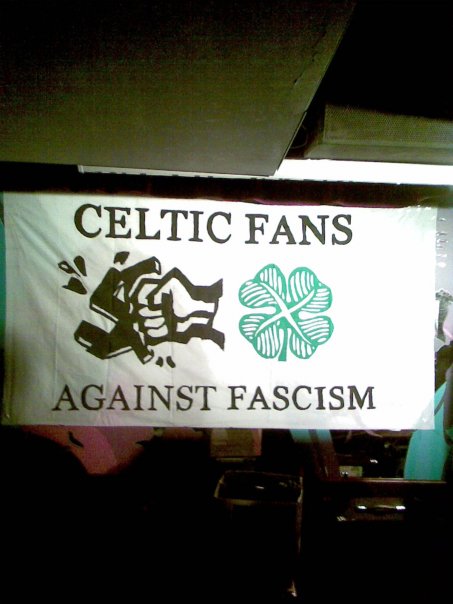
Celtic fans witnessed racism in their ranks and autonomously dealt with it – through dialogue with fans, through starting a fanzine to spread the word and through confronting racists en masse in and out of the stands to draw the line that racism is not acceptable. Crucially, from within the fan base, not from UEFA, or the SFA or whatever – but from the people you share the stands with week in and week out.
It’s an over-simplification of course, but fundamentally, a tannoy message and a celebrity telling a racist that monkey chants aren’t acceptable doesn’t make them sit down – it’s too external. As well intentioned as “Kick it Out” is, it ignores the relationship with the fans – it’s being expressed by the same people who fuck with our kick off times, who allow sky high ticket prices, who instruct stewards to kick people out for standing and so on – the super structure of football. You cannot safely predict that people who are reticent, angry or ambivalent about an FA mouthpiece most of the time to sit up and take notice of the same mouthpiece when it talks sense now and again. Legitimate or otherwise, I know from myself that football supporters are not always the most logical – risking relationships and your job to lose your voice as you watch your team lose in the rain in Hartlepool is par for the course. It’s not to say that fans don’t necessarily care – but an important campaign can be lost in a sea of complacency and routine. Playing the same old recorded message about abuse from the stands can just fall into the same sonic landscape of a bad tannoy system telling you not to stand or that the match ball is sponsored by a local car showroom. It gets lost in routine and people become detached from the message. Anti racism ceases to be about active dissent – it falls helplessly into the audio and visual spectacle of detached fan compliance. Fundamentally, whilst campaigns like Kick it Out could be better (perhaps with UEFA actually taking racism seriously, for starters), there is not much above that that they can do. But a majority of fans drowning out such abuse, confronting it in numbers and winning the political argument from within the stands – that tends to be a different story.
We can’t be complacent and rely on liberal campaigns, the only way to really tackle racism is for fans themselves to take responsibility for what goes on in our stands. When people hear something at the ground that offends them and feel too nervous to speak out (confrontations at the best of times can be very intimidating, and no less so at the football), all too often nothing but an awkward silence follows. People may not realise that they are potentially surrounded by dozens of other people in earshot who feel just as offended – but just as intimidated. But how would they know if we don’t talk about it? That’s why, even if you don’t think your club has a problem, that talking about discrimination with your friends in the stands, on the messageboards, in the pub and so on, is so important. When and if something like this happens, you can know that it’s not just you – but that other supporters feel just the same way and that can make the difference between keeping your mouth shut or standing up and doing something about it. And that’s not just at your club – people may be over-zealous about the idea of “fan community”, but actions and words spread. If you and your friends make a stand at one game, it can inspire other clubs to do it too. Share your experiences online or pre/post match with fans of other clubs – you’ll be surprised just how many people are interested but felt too isolated and/or needed the inspiration to do something.
Drown it out with other chants, confront the perpetrator, boo – anything to make sure that the person realises that they are disgusting and offending their own fans. People they may see every week and love the club just as much. It’s a first step. So don’t assume that everything’s ok – get talking and discussing! Create a fanzine! Make a banner with your friends! And that means, me, you and anyone else who enjoys going to the football – because we are all responsible for our game.

See also:
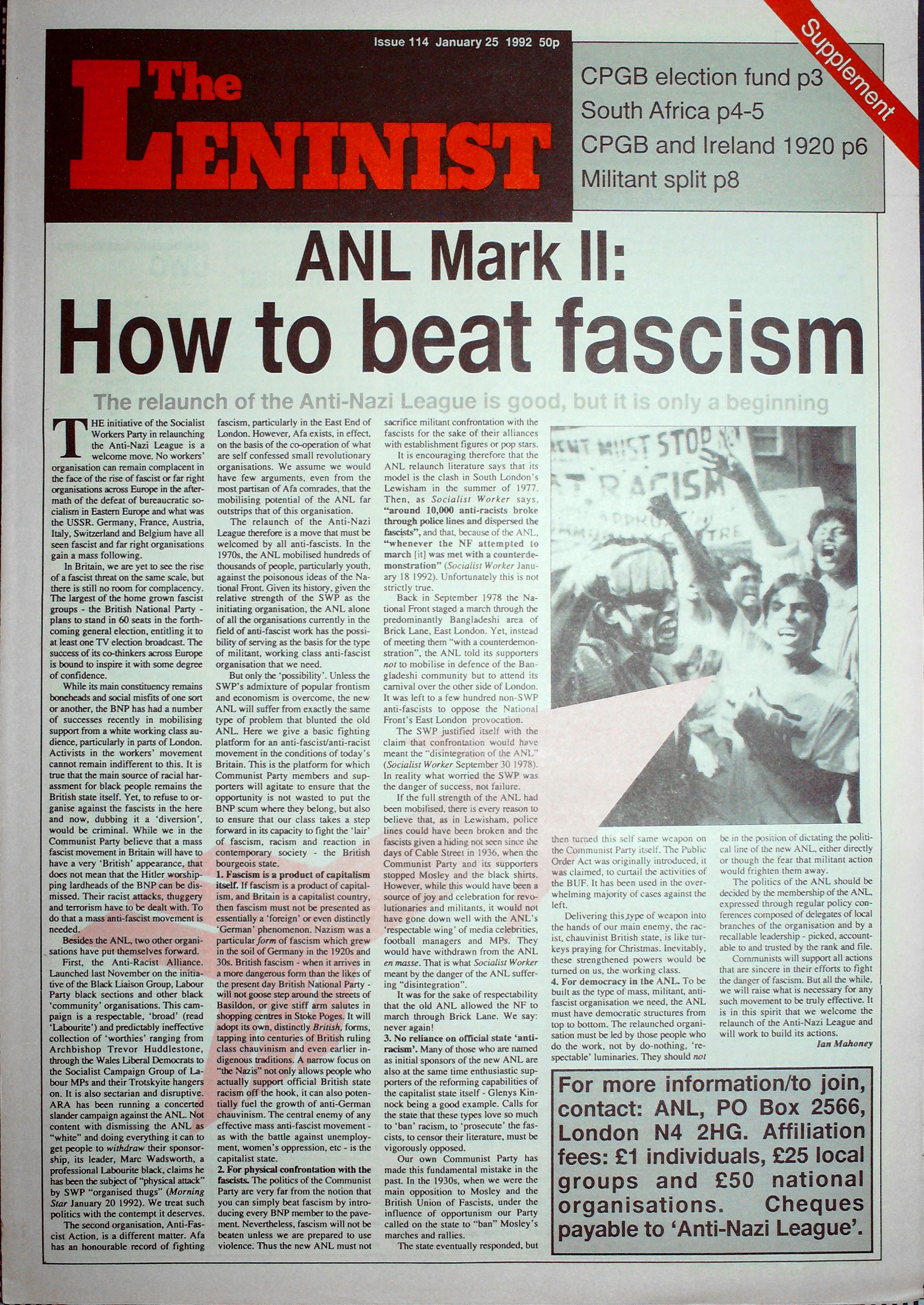
The back copies of The Leninist, the journal of the Communist Party of Great Britain and later the CPGB Provisional Central Committee, have been uploaded. Visit this site to view issue 1 through 116.
Issue 114 details the relaunch of the Anti-Nazi League by the Socialist Workers’ Party. The Leninist supports the new ANL over Anti-Fascist Action because they suspect it will be able to field more numbers. It does commend AFA for its work and calls for a continuation of the physical confrontation of fascists.


 Anti-Fascist Archive